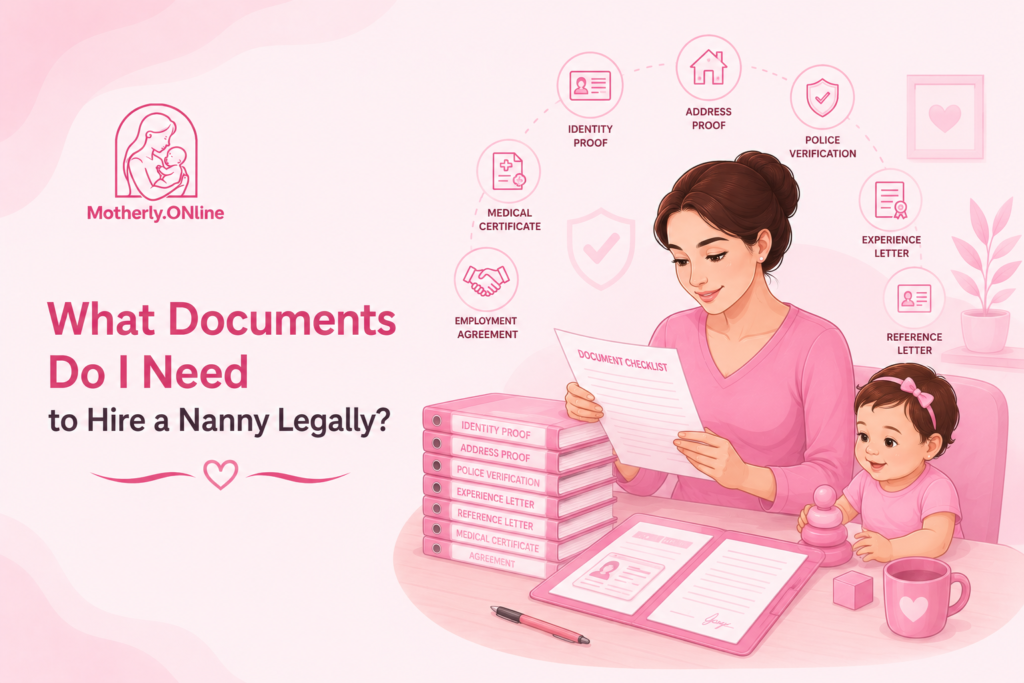

Hiring a nanny is one of the most significant decisions a family can make you are bringing someone into your home, giving them access to your children, your belongings, and your daily life. Getting the paperwork right is not bureaucratic box-ticking. It is the foundation of a safe, transparent, and legally sound employment relationship for both you and your nanny.
In India, while there is no single central law exclusively governing the hiring of domestic workers or nannies, the legal landscape has become significantly clearer since the implementation of the four new Labour Codes in November 2025 which for the first time extend minimum wage protections and certain employment rights to domestic workers. Many metropolitan cities also have local society regulations, Resident Welfare Association (RWA) requirements, and state-level rules that make formal documentation not just advisable but mandatory.
This guide covers every document you need from the nanny’s identity papers to the employment agreement, police verification, and health certificates with specific guidance for Indian families. Whether you are hiring through an agency, through a reference, or independently, this checklist will help you do it correctly.
Table of Contents
Why Proper Documentation Matters When Hiring a Nanny?
Many Indian families hire nannies through word of mouth or domestic help agencies without collecting or verifying any formal documents. This practice, while common, exposes both parties to significant risks.
| Risk Without Documentation | Who Is Affected | How Documentation Helps |
| Identity fraud — nanny using false name or someone else’s documents | Family | Aadhaar + police verification confirms real identity |
| Criminal background hidden from employer | Family / children | Police verification certificate reveals any criminal record |
| No legal record of employment terms — salary disputes later | Both parties | Written employment agreement prevents disputes |
| RWA / housing society denies entry to unverified worker | Both parties | Police clearance certificate required for gate pass |
| Nanny has no proof of employment for future references | Nanny | Employment agreement and pay records serve as proof |
| No legal clarity if the nanny is injured at work | Both parties | Agreement + insurance clause protects both sides |
| Exploitation of nanny — no documented salary or leave terms | Nanny | Written agreement ensures legal wage compliance |
| Important Legal Context : India 2025 Under India’s new Code on Wages (implemented November 2025), domestic workers including nannies are now entitled to minimum wage for the first time under centralised law. This means the employment agreement you create is not merely a formality; it is a document that must reflect legally compliant wage terms. Underpaying your nanny relative to your state’s minimum wage is now a legal compliance issue, not just an ethical one. |
Part A: Documents You Need FROM Your Nanny
These are documents the nanny must provide to you her employer before beginning work. Collect originals for viewing and keep photocopies in a dedicated file.
Document 1: Aadhaar Card (Mandatory)
- The Aadhaar card is India’s primary biometric identity document and is the single most important document to collect from your nanny
- Verify that the photograph matches the person in front of you
- Check that the Aadhaar number is 12 digits and the QR code is scannable
- You can verify the Aadhaar online at uidai.gov.in using the ‘Verify Aadhaar’ feature free and instantIf the nanny does not have an Aadhaar, ask for a Voter ID + PAN card combination as an alternative
- Keep a clear photocopy – both sides – in your records
An Aadhaar card without a matching face is a major red flag. Do not proceed with hiring if the photograph does not clearly match the person presenting it.
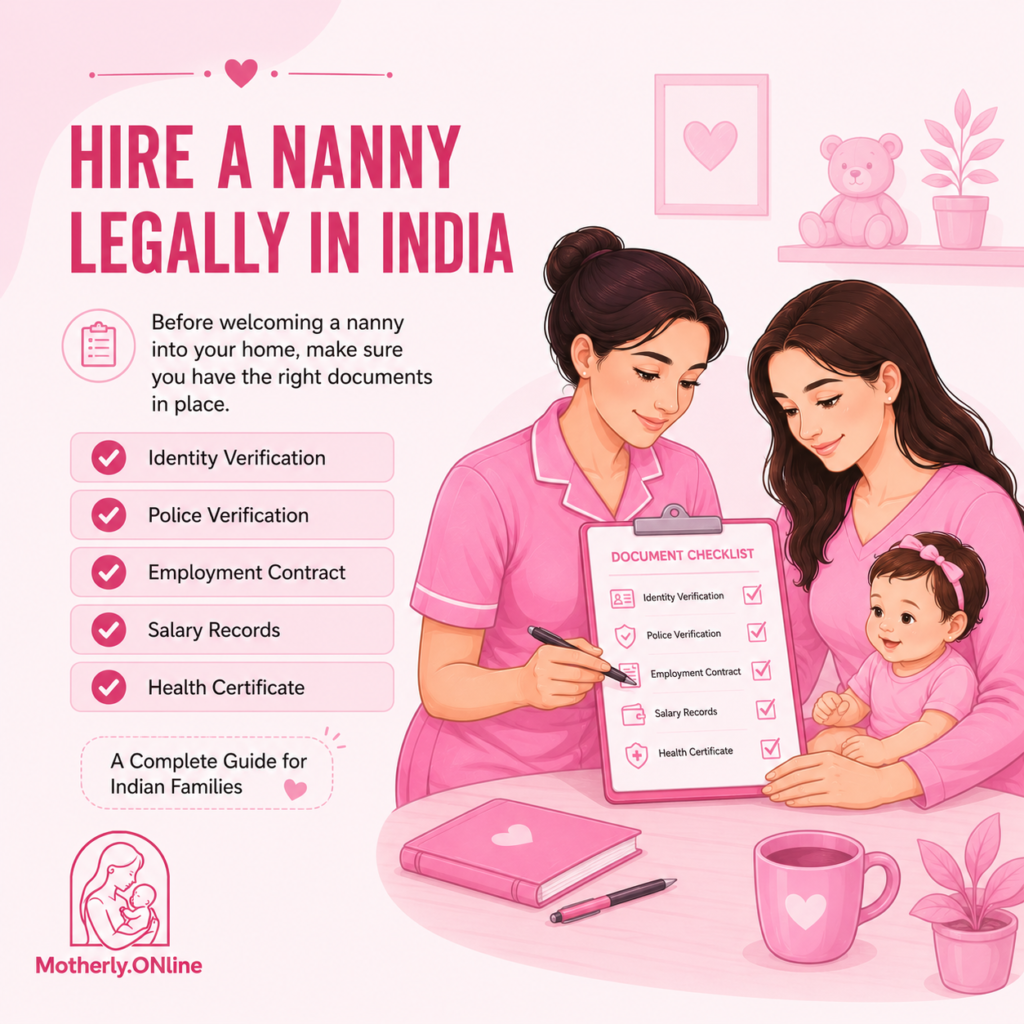
Document 2: Address Proof — Current AND Permanent (Mandatory)
- You need TWO address proofs:
- (a) current address where the nanny is presently living, and
- (b) permanent / home-town address
- This is critical because many nannies are migrants from other states; knowing their home address is important for police verification and emergency contact
- Accepted documents for address proof: Aadhaar card (if address is updated), Voter ID card, Ration Card, Utility bill (electricity/water/gas – not older than 3 months), Bank passbook with current address, Rental agreement for current residence
- If the nanny is staying in a shared PG or at her previous employer’s home, ask for a letter from the owner confirming her residence
- Physically verify the current address if possible or ask a trusted contact to do so
Some nannies provide their hometown address as their current address if they are new to the city. In this case, collect both the home state address and any available local contact.
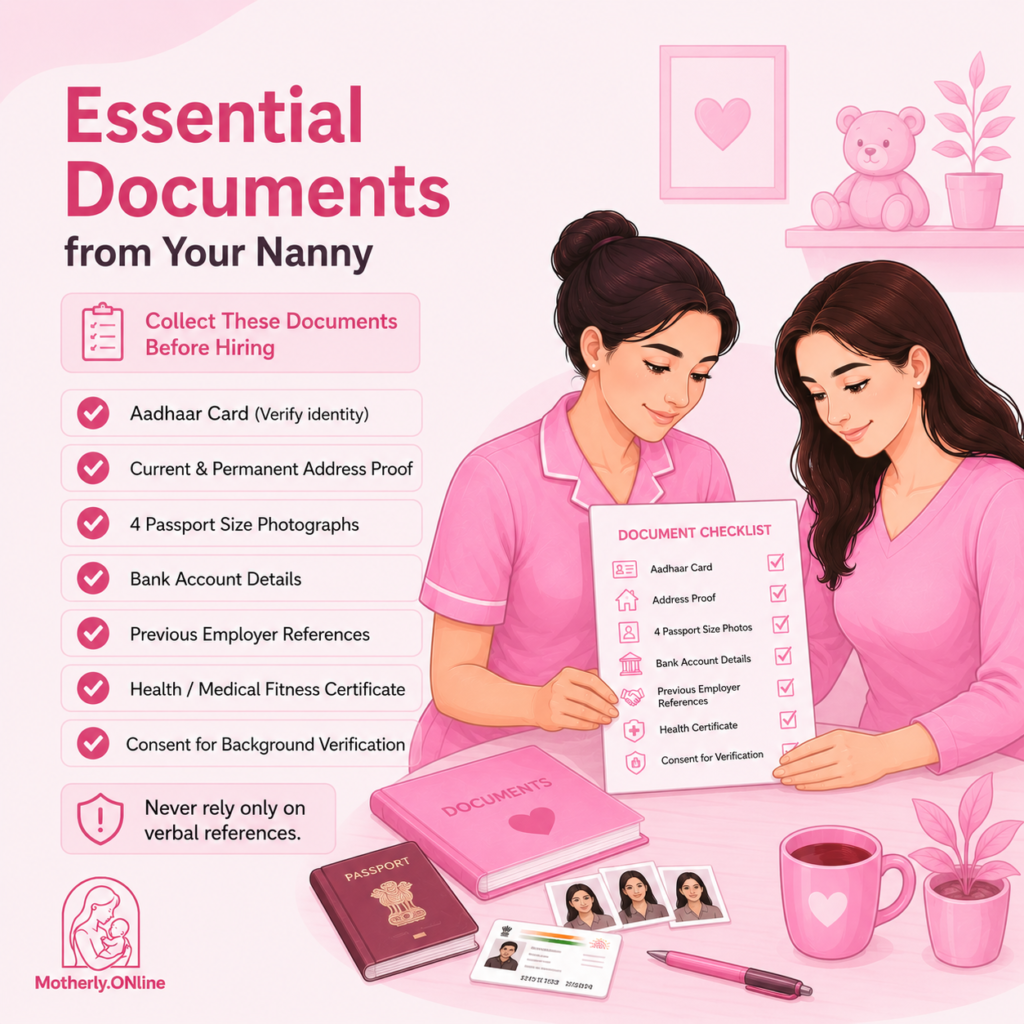
Document 3: Passport-Size Photographs (Mandatory)
- Collect at least 4 recent passport-size photographs (not older than 6 months)
- Required for: police verification application, RWA/society gate pass, employment file record
- Ensure the photographs are clear and show the face without sunglasses, heavy filters, or headwear (unless worn for religious reasons)
Digital photographs sent via WhatsApp are often too low in resolution for official use. Ask for physical printed photographs
Document 4: Additional Identity Documents (Recommended)
– PAN Card – particularly important if you intend to pay salary above Rs 20,000/month and want to keep formal tax records
– Voter ID Card – strong secondary identity document with address
– Passport – if available; provides additional identity confidence
– Driving Licence – if the nanny is expected to drive
– School Leaving Certificate or any educational qualification documents
– Any previous childcare training certificates or first-aid training certificates
You do not legally need all of these, but having two forms of identification significantly reduces identity fraud risk.
Document 5: Reference Letters from Previous Employers (Strongly Recommended)
– Ask for references from at least 2 previous employers ideally in writing
– A reference letter should include: employer’s name and contact number, duration of employment, nature of duties, reason for leaving, character assessment
– Always call the reference personally do not just read the letter. Confirm the details match what the nanny told you
– Ask specific questions: Was she punctual? Did she ever take the children out alone? Did she follow instructions? Would you hire her again?
– If the nanny has no previous references (first job), ask for a character reference from a school teacher, community leader, or religious leader
Do not skip reference checks. This is where many families discover discrepancies between what the nanny claims and what actually happened.
Document 6: Bank Account Details (Mandatory for Salary Payment)
– Collect the nanny’s bank account number and IFSC code for salary transfer
– Paying salary by bank transfer (NEFT/UPI) creates a digital record far preferable to cash payments for both legal compliance and dispute prevention
– Ask for a cancelled cheque or a photograph of the bank passbook front page
– If the nanny does not have a bank account, assist her in opening one (Jan Dhan accounts are free and easy to open with Aadhaar)
– Keep monthly salary transfer receipts in your records — these serve as proof of employment
Under India’s new Labour Codes (2025), wage payment records must be maintained. Bank transfers are the simplest way to fulfil this requirement.
Document 7: Health / Medical Fitness Certificate (Recommended for Childcare)
– A basic health certificate from a government doctor or registered clinic confirming the nanny is free from communicable diseases
– Particularly important when the nanny will be caring for infants, newborns, or immunocompromised children
– Ask for: general fitness certificate, TB (tuberculosis) clearance, and if applicable, vaccination records (Hepatitis B, typhoid, COVID-19)
– Some premium nanny agencies and paediatric specialists strongly recommend HIV status disclosure with consent
– A fitness certificate is typically available from a government PHC for a nominal fee (Rs 50–100)
While not legally mandated in most states, a health certificate demonstrates due diligence in childcare hiring and protects your children.
Document 8: Consent Form for Background Verification (Mandatory)
– Before conducting any background check including police verification obtain the nanny’s written consent
– A consent form should state: purpose of verification, what records will be checked (identity, address, criminal record, employment history), who will conduct the verification, and how the information will be used and stored
– This protects you legally under the Digital Personal Data Protection Act 2023 (DPDP Act) which requires consent before collecting and processing personal data
– Most background verification services (NoBroker, EzyHelpers, Quinfy) provide standard consent forms
– The nanny has the right to know what is being checked do not conduct hidden background searches without consent
Under India’s DPDP Act 2023, collecting personal data without consent can expose you to legal liability. Always get written consent before verification.
How to Hire a Nanny in India: Agencies, Apps, and What Actually Works?
Part B: Documents YOU (the Employer) Must Create
These are documents that you as the employer are responsible for creating and providing to your nanny. They protect both of you and establish the formal employment relationship.

Document 9: Written Employment Agreement / Nanny Contract (Most Important)
A written employment agreement is the single most important document in the entire nanny hiring process.
It protects both you and the nanny by clearly documenting agreed terms before employment begins
A comprehensive nanny agreement for India should include the following:
- Full legal names and addresses of both employer and nanny
- Start date of employment and job title
- Daily working hours (including start time, end time, break time)
- Weekly off days and monthly leave entitlement
- Monthly salary amount (must meet or exceed state minimum wage)
- Payment date and method (bank transfer preferred)
- Job duties and responsibilities (childcare, feeding, bathing, school drop, etc.)
- Duties that are explicitly NOT required (e.g. heavy housework)
- Accommodation details if live-in
- Notice period for resignation or termination (typically 30 days)
- Confidentiality clause (no sharing of family information, photos of children on social media)
- Annual leave and festival/public holiday entitlement
- Sick leave provision
- Annual increment or bonus terms
- Conduct and disciplinary expectations
- Conditions for immediate termination
- Emergency contact information
Both parties must sign two copies – one for the employer’s file, one for the nanny to keep. A nanny who refuses to sign a written agreement is a significant red flag.
Document 10: Offer Letter (Recommended)
- An offer letter is a shorter summary document issued before the full agreement is signed
- It confirms: the position offered, start date, salary, reporting relationship, and main duties
- Even if you eventually sign a full agreement, an offer letter gives the nanny something to review before committing
- It also demonstrates that you are a professional, serious employer which attracts better candidates
Think of the offer letter as the ‘preview’ and the employment agreement as the ‘full contract.’ For most home hiring, both can be combined into one document.
Document 11: Salary Slip / Pay Record (Monthly — Mandatory Under Labour Codes 2025)
- Under India’s Code on Wages 2025, employers must maintain wage records for all workers, including domestic help
- Issue a simple salary slip each month containing: employee name, month, basic salary, any deductions, net amount paid, and payment date
- A WhatsApp message confirming payment or a bank transfer receipt can serve as a basic record
- Retain at least 3 years of salary payment records
- If the nanny requests a formal salary certificate for any purpose (loan, visa), you are legally expected to provide one
Maintaining salary records protects you in the event of a wage dispute which is the most common source of conflict between families and domestic workers.
Part C: Police Verification – The Non-Negotiable Safety Step
Police verification is the process of submitting your nanny’s identity documents to the local police station, which checks the individual’s criminal record and verifies address history. In many Indian cities, this is now effectively mandatory both by law and by RWA/housing society requirements.
Is Police Verification Mandatory?
Legally required: Several metro cities have mandatory police verification for domestic workers by local police order Delhi, Mumbai (many areas), Bengaluru, Pune, and Hyderabad all have active requirements or strong advisory frameworks. Many gated societies and apartment complexes require police verification before issuing a staff entry gate pass without this, your nanny may be denied entry entirely.Highly recommended everywhere: Even where not legally mandated, the National Crime Records Bureau (NCRB) and police forces across India actively recommend police verification for all domestic workers.
Documents Required for Police Verification of a Nanny in India
| Document | Details |
| Nanny’s Aadhaar Card | Clear photocopy both sides. Must be legible and photo must match |
| 2 Passport-Size Photos | Recent, clear photographs of the nanny |
| Current Address Proof | Aadhaar (if address is updated), utility bill, or rental agreement |
| Permanent Address Proof | Voter ID, ration card, or home-state Aadhaar |
| Employer’s ID Proof | Your Aadhaar or any government-issued photo ID |
| Employer’s Address Proof | Utility bill or Aadhaar confirming your home address |
| Application Form | Police verification application form available at local police station or state portal |
| Nanny’s Mobile Number | A working mobile number for police contact during verification |
| Nanny’s Consent | Signed consent form most states now require this |
How to Apply for Police Verification — State-by-State
| City / State | Method | Fee & Timeline |
| Mumbai / Maharashtra | Visit local police station OR apply via Aaple Sarkar portal (aaplesarkar.mahaonline.gov.in) | Rs 0–100 | 7–21 working days |
| Delhi | Apply online at Delhi Police portal (delhipolice.gov.in) — Domestic Help Verification section | Rs 0 | 10–21 working days |
| Bengaluru / Karnataka | Apply via Seva Sindhu portal (sevasindhu.karnataka.gov.in) | Rs 249 | 10–15 working days |
| Hyderabad / Telangana | Apply online at Meeseva portal or visit local PS | Rs 50–100 | 10–21 working days |
| Pune | Visit local police station with documents. Online option via Maharashtra portal | Rs 50–100 | 10–21 working days |
| Chennai / Tamil Nadu | Apply via police district portal or visit local police station | Rs 50 | 14–21 working days |
| Other cities | Visit your nearest police station with documents. Request domestic servant verification form | Rs 0–200 | 14–30 working days |
Tip: Use a Professional Verification Service
If the police verification process feels overwhelming, professional services like NoBroker Home Services, EzyHelpers, Quinfy, and JantaKhoj can handle the entire process for you including address verification, criminal record check, and police verification filing. Fees typically range from Rs 500–1,500 for a complete background verification report. This is one of the best investments you can make when hiring a nanny.
Part D: Hiring Through an Agency vs. Independently – Document Differences
| Document / Step | Agency Hire | Independent Hire |
| Identity documents | Agency collects and verifies request copies | You collect and verify yourself |
| Police verification | Reputable agencies provide pre-verified staff ask for the report | You must apply for police verification |
| Employment agreement | Agency may provide a standard template review carefully | You must create or download your own agreement |
| Background check | Agency typically conducts this as part of their service | You must arrange independently (NoBroker, Quinfy etc.) |
| Training certificates | Agency nannies often have documented training ask to see certificates | You must assess skills directly |
| Reference checks | Agency may have verified references ask for original employer contact details and call yourself | You must check references directly |
| Health certificate | Some premium agencies provide this ask specifically | You must request this from the nanny |
| Salary slip / payroll | Your responsibility regardless of agency source | Your responsibility |
Important Warning About Agency Hiring
Even when hiring through an agency, do not assume all documentation is in order. Many budget agencies in India do not conduct rigorous verification. Always request copies of all documents the agency claims to have verified, personally call references, and still submit police verification independently if needed. An agency placement does not remove your responsibility to do due diligence.
Part E: Legal Compliance – What Indian Law Requires in 2025–2026
India’s new Labour Codes (implemented November 2025) significantly changed the legal landscape for domestic worker employment. Here is what you need to know as a family hiring a nanny:
| Legal Requirement | What It Means for Nanny Employers |
| Minimum Wage (Code on Wages 2025) | Domestic workers are now covered under the minimum wage framework. Check your state’s current minimum wage for unskilled/semi-skilled workers. Paying below this amount is a legal violation. |
| Written Appointment Letter | Under the OSHWC Code 2025, employers must issue a written appointment letter in a prescribed form. An employment agreement fulfils this requirement. |
| Wage Payment Records | Employers must maintain wage payment records. Salary slips and bank transfer records fulfil this requirement. |
| Leave Entitlement | Workers are entitled to paid leave. Your agreement should specify leave terms in compliance with state rules typically 1 day paid leave per 20 days worked. |
| DPDP Act 2023 (Data Privacy) | You must obtain written consent before collecting and processing personal data (Aadhaar, address, bank details) from your nanny. A consent form at hiring fulfils this. |
| No Forced Labour / Contract Bonding | You cannot retain original documents (Aadhaar, passport) as ‘security.’ You may take photocopies only. Retaining originals is illegal. |
| Maternity Benefits | Under the Maternity Benefit Act (still applicable to domestic workers), a nanny is entitled to 12 weeks of paid maternity leave if she has worked for you for at least 80 days. This should be addressed in your agreement. |
Complete Document Checklist – Print and Keep
Documents to Collect FROM Your Nanny
- Aadhaar Card original viewed, photocopy retained (both sides)
- Current Address Proof (utility bill / rental agreement / updated Aadhaar)
- Permanent / Hometown Address Proof (Voter ID / Ration Card / Aadhaar)
- 4 recent passport-size photographs
- PAN Card (if paying salary above Rs 20,000/month)
- Voter ID Card (secondary identity backup)
- Reference letters from minimum 2 previous employers
- Previous employer phone numbers personally verified by you
- Bank Account Number and IFSC Code (cancelled cheque / passbook photo)
- Health / Medical Fitness Certificate from registered doctor
- Any childcare training or first-aid certificates held
- Signed Consent Form for Background Verification
Documents YOU Must Create as Employer
- Written Employment Agreement signed by both parties, 2 copies
- Offer Letter (optional but recommended)
- Monthly Salary Slips to be issued every month
- Police Verification Application submitted to local station or online portal
- Police Verification Certificate file once received
- Society / RWA Gate Pass application (with police clearance attached)
Ongoing Records to Maintain
- Bank transfer records / UPI receipts for every salary payment
- Leave records (days taken, days remaining)
- Any written warnings or incidents (if applicable)
- Annual police verification renewal (recommended every 1–2 years)
- Updated address records if nanny changes residence
What If Your Nanny Has No Documents?
This is a common situation particularly for nannies from rural areas or those new to the city who may not have updated address documents. Here is how to handle each scenario:
| Situation | What To Do |
| Nanny has no Aadhaar card | Assist her in enrolling for Aadhaar at the nearest Aadhaar enrolment centre. This is free. Do not hire before she has at least enrolled and has an enrolment slip. |
| Aadhaar address is outdated (home-state address, not current city) | Accept the hometown Aadhaar as permanent address proof. Collect a separate current address proof (rental agreement, employer letter, or utility bill from current residence). |
| No bank account | Accompany her to open a Jan Dhan account at any nationalised bank it is free with Aadhaar and takes one day. This is essential for salary payment records. |
| No previous employer references | For a first-time nanny, ask for a character reference from a school principal, priest, temple trustee, or community leader from her hometown ideally with a contact number. |
| Nanny objects to police verification | Treat this as a serious concern. A legitimate nanny with nothing to hide will cooperate with police verification. If she refuses, reconsider hiring her. |
| Nanny has no health certificate | Take her to the nearest government PHC or clinic yourself before she starts work, particularly if she is caring for a newborn. |
Myth vs. Fact – Hiring a Nanny Legally in India

| Myth | Fact |
|---|---|
| If a nanny comes through a trusted reference, documents are not necessary. | References reduce risk but do not eliminate it. Identity fraud and concealed criminal history have occurred even with personal references. Collect documents regardless of the source. |
| Police verification takes months and is not worth the effort. | Most Indian states now have online police verification portals. The process generally takes 10–21 working days in most metro cities. Professional services can often complete it in a week or less. |
| A written agreement is only for big corporate jobs it is unusual and unnecessary for a nanny. | A written agreement is essential in domestic employment. Misunderstandings regarding salary, working hours, leave, and responsibilities are common. A contract protects both the family and the nanny. |
| You can keep the nanny’s original Aadhaar card as a security deposit. | Retaining original identity documents is illegal. Families may keep photocopies for records, but holding original documents can amount to coercion and may expose the employer to legal liability. |
| Labour laws don’t apply to domestic workers in India. | Domestic workers are increasingly covered under labour protections. Families hiring nannies should stay informed about applicable minimum wage rules and employment regulations in their state. |
| Once hired, the same documents are valid forever no need to update. | Documents should be reviewed periodically. Police verification is recommended every 1–2 years, especially if the nanny changes her address or rejoins after a long gap. Re-verification helps maintain safety and compliance. |
Additional Safety Tips for Families
- Never share your home passwords, locker combinations, or banking details with a nanny, regardless of how long she has worked for you
- Install a CCTV camera in common areas (with consent and clear notice to the nanny) for mutual safety it protects both of you in case of any dispute
- Have an emergency protocol: make sure the nanny knows emergency contact numbers, the nearest hospital, and what to do if a child is injured
- Do not ask your nanny to sign documents she cannot read have someone translate if she speaks a different language, and ensure she genuinely understands what she is agreeing to
- Treat your nanny with dignity and respect a nanny who feels fairly treated is less likely to abruptly abandon employment, and more likely to provide consistent, engaged care for your child
- Review your agreement annually update salary in line with minimum wage revisions and discuss any changes in duties or hours
FAQ
What documents do I need to hire a nanny legally in India?
You need: Aadhaar card, current and permanent address proof, passport-size photos, police verification certificate, reference letters from previous employers, bank account details, signed employment agreement, health certificate, and consent form for background check. Keep photocopies of all documents.
Is police verification mandatory for hiring a nanny in India?
Police verification is legally required or strongly mandated in many Indian cities including Delhi, Mumbai, Bengaluru, Hyderabad, and Pune — both by local police orders and by most RWAs and gated societies. It is strongly recommended everywhere in India regardless of legal requirements.
What should a nanny employment agreement include in India?
A nanny agreement in India should include: full names and addresses, start date, working hours, salary amount (must meet minimum wage), payment method, duties, weekly off days, leave entitlement, notice period, confidentiality clause, conduct expectations, and termination conditions. Both parties must sign.
Can I retain a nanny’s Aadhaar card as a security deposit?
No. Retaining original identity documents is illegal in India. You may take photocopies of the Aadhaar and other documents for your records, but original documents must be returned to the nanny.
How do I conduct police verification for a nanny in India?
Visit your local police station with the nanny’s Aadhaar, address proof, and photographs, along with your own ID and address proof. Many cities now have online portals: Delhi Police, Maharashtra Aaple Sarkar, Seva Sindhu (Bengaluru). Fees range from Rs 0–249 and processing takes 10–21 working days.
Do labour laws apply to nannies in India?
Visit your local police station with the nanny’s Aadhaar, address proof, and photographs, along with your own ID and address proof. Many cities now have online portals: Delhi Police, Maharashtra Aaple Sarkar, Seva Sindhu (Bengaluru). Fees range from Rs 0–249 and processing takes 10–21 working days.
What is the minimum wage for a nanny in India?
Visit your local police station with the nanny’s Aadhaar, address proof, and photographs, along with your own ID and address proof. Many cities now have online portals: Delhi Police, Maharashtra Aaple Sarkar, Seva Sindhu (Bengaluru). Fees range from Rs 0–249 and processing takes 10–21 working days.
Do I need a written agreement to hire a nanny at home in India?
Yes. Since November 2025, India’s new Labour Codes extend minimum wage protections to domestic workers including nannies. This means you must pay at least the state-level minimum wage and maintain wage payment records.
What is the minimum wage for a nanny in India?
Minimum wage varies by state and is set by each state government. It is typically categorised for unskilled or semi-skilled workers. Check your state labour department website for the current rate. Under the Code on Wages 2025, all domestic workers must receive at least the applicable minimum wage.
Do I need a written agreement to hire a nanny at home in India?
Yes. While not always legally enforced for domestic employment historically, a written agreement is now required under the OSHWC Code 2025 as an appointment letter. It also protects both you and the nanny from disputes about salary, hours, and leave.
What documents does a nanny need to provide to a housing society?
Most housing societies require: Aadhaar card photocopy, police verification certificate, 2 passport-size photographs, and employer’s letter confirming employment. Contact your specific RWA for their exact requirements as these vary.
How can I verify a nanny’s background in India?
You can verify through: (1) local police station police verification, (2) online portals (Delhi Police, Seva Sindhu, Aaple Sarkar), (3) professional background verification services like NoBroker, EzyHelpers, or Quinfy, which check identity, address, criminal records, and employment history.
What if my nanny doesn’t have an Aadhaar card?
Assist her in enrolling for Aadhaar at the nearest enrolment centre — it is free. As alternatives, a Voter ID card plus PAN card combination can serve as identity proof. Do not begin employment without at least one verified government-issued photo ID.
How long should I keep a nanny’s documents on file?
Keep all employment documents for at least 3 years after employment ends. Under labour law, wage records must be maintained for 3 years. Police verification certificates should be renewed every 1–2 years during active employment.
What are the rights of a nanny in India?
Under India’s Labour Codes 2025, nannies are entitled to: minimum wage, paid leave (1 day per 20 days worked), maternity benefits (if worked 80+ days), protection from withheld wages, and the right to receive a written appointment letter. They also have data privacy rights under the DPDP Act 2023.
How do I hire a nanny through an agency legally in India?
When hiring through an agency: verify the agency’s registration, ask for copies of all documents the agency verified, personally call all references, check that the police verification is current, sign your own employment agreement directly with the nanny, and always pay salary directly to the nanny (not through the agency) after the initial placement.
What is a domestic worker consent form and why do I need one?
A consent form is a written document in which the nanny agrees to allow you to collect her personal data (Aadhaar, address, bank details) and conduct a background check. It is required under India’s Digital Personal Data Protection Act 2023. Most background verification services provide a standard template.
Key Takeaways
- The six essential documents to collect from your nanny are: Aadhaar card, address proof (current and permanent), photographs, reference letters, bank account details, and a health certificate
- You must create two key documents: a written employment agreement and monthly salary slips
- Police verification is effectively mandatory in most Indian cities and is required by most RWAs apply online or at your local police station
- Since November 2025, India’s Labour Codes now extend minimum wage protections to domestic workers your agreement must reflect a legally compliant salary
- Never retain original documents (Aadhaar, passport) photocopies only. Retaining originals is illegal
- Always conduct reference checks by personally calling previous employers do not rely on written references alone
- Professional background verification services (NoBroker, EzyHelpers, Quinfy) make the entire process manageable for families without time to navigate it themselves
Final Words
Hiring a nanny who is a good fit for your family is a beautiful thing it creates safety, support, and continuity for your child during some of the most formative years of their life. Getting the paperwork right from the beginning ensures that this relationship starts on a foundation of trust, legal clarity, and mutual respect.
The documentation process is not about bureaucracy or distrust. It is about creating a professional employment relationship one that protects your child’s safety, your nanny’s rights, and your family’s security all at once. An hour spent on paperwork at the beginning saves weeks of conflict and heartache later.
At Motherly.ONline, we are committed to helping Indian families navigate every dimension of childcare from finding the right nanny to understanding the legal frameworks that govern her employment. For personalised guidance, explore our directory of verified nanny services and parenting experts across India.
| Disclaimer: This article is for general informational purposes only. It does not constitute legal advice. Labour laws, minimum wages, and police verification requirements vary by state and are subject to change. Always consult a qualified legal professional for advice specific to your situation and location. Motherly.ONline takes no responsibility for outcomes resulting from the use of this information. |