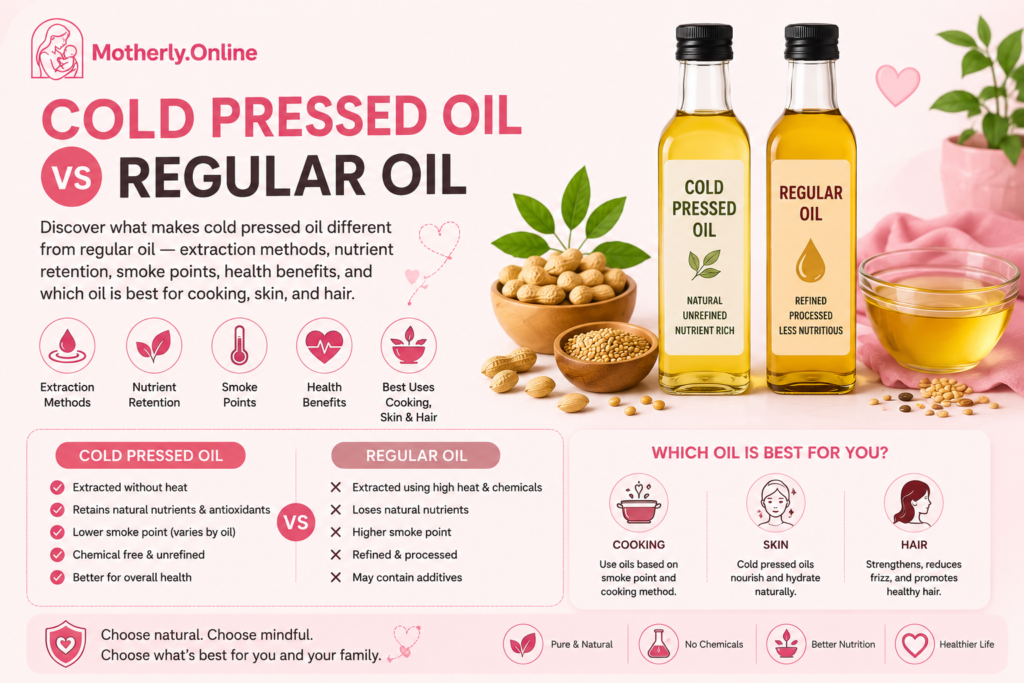

What Is Cold Pressed Oil?
Cold pressed oil is oil extracted from seeds, nuts, or fruits using mechanical pressure alone without applying external heat, chemical solvents, or high-temperature processing. The term “cold pressed” means the temperature during extraction stays below 49°C (120°F), which is the threshold at which heat begins degrading delicate nutrients.
Also known as kachi ghani oil, lakdi ghani oil, wooden cold press oil, expeller cold press oil, or simply raw oil, cold pressed oil retains the natural flavor, aroma, color, antioxidants, vitamins, essential fatty acids, and phytonutrients that are present in the original seed or nut.
Cold pressing is one of the oldest oil extraction methods in the world. Traditional Indian methods like kachi ghani (stone mortar pressing) and wooden ghani pressing are early forms of cold pressing that have been used for centuries to produce oils such as mustard oil, sesame oil, and groundnut oil.
Table of Contents
Cold Pressed Oil: Quick Definition
Cold pressed oil = mechanical extraction + no added heat + no chemical solvents + maximum nutrient retention
What Is Regular (Refined) Oil?
Regular oil, commonly called refined oil, processed oil, or commercial cooking oil, is produced using a combination of high heat, chemical solvents (usually hexane), and multiple refining stages including degumming, neutralization, bleaching, and deodorization (a process called RBD — Refined, Bleached, Deodorized).
The goal of refined oil production is maximum yield, longer shelf life, a neutral taste, and a consistent appearance not maximum nutrition. The result is a clear, odorless oil that has had most of its natural compounds stripped away in the process.
Cold Pressed Oil Extraction Process Explained
Understanding how cold pressed oil is made explains why it retains so much more nutrition than regular oil.
Step 1: Seed Cleaning and Preparation
Raw seeds, nuts, or fruits (sesame, sunflower, mustard, coconut, flaxseed, groundnut, almond, etc.) are cleaned and sometimes lightly dried to remove surface moisture.
Step 2: Mechanical Pressing (Cold Press Extraction)
The seeds are fed into a cold press machine (also called an expeller press or oil press machine) that uses a screw or ram to crush and press the seeds at low speed. The friction generated during pressing does produce some heat, but in genuine cold pressing, the temperature is carefully controlled to stay below 49°C.
Traditional methods use a wooden ghani press (a large rotating stone or wooden mortar and pestle driven by bullocks or an electric motor), which generates even less heat than modern expeller presses.
Step 3: Oil Filtration
The extracted oil is collected and passed through natural filters (cloth, paper, or centrifuge) to remove seed solids and sediment. No chemicals are used at this stage.
Step 4: Settling and Bottling
The filtered oil is allowed to settle, then bottled and sealed. No preservatives, antioxidant additives, or bleaching agents are added.
Oil yield: Cold pressing typically yields 60–70% of the oil available in the seed. The remaining oil stays in the seed cake (called oil cake or presscake), which is used as animal feed.
How Regular Oil Is Made: Solvent Extraction & Refining
Refined oil production is a multi-stage industrial process optimized for volume and shelf life.
Stage 1: Seed Preparation and Pre-pressing
Seeds are cleaned, flaked, and sometimes pre-pressed to break cell walls and release oil more easily.
Stage 2: Solvent Extraction with Hexane
The flaked seeds are flooded with n-hexane, a petroleum-derived chemical solvent. Hexane dissolves the oil out of the seed material, achieving a 99%+ oil extraction rate. The hexane-oil mixture (called miscella) is then heated to evaporate the hexane, leaving behind crude oil.
Hexane residues: While most hexane evaporates, trace residues can remain in the final refined oil. Hexane is classified as a neurotoxin by occupational health bodies at high exposures.
Stage 3: Degumming
Crude oil is treated with water or acid to remove phospholipids and gums.
Stage 4: Neutralization (Alkali Refining)
Sodium hydroxide (caustic soda) or sodium carbonate is added to remove free fatty acids and other impurities, producing soapstock as a byproduct.
Stage 5: Bleaching
The oil is mixed with bleaching earth or activated charcoal to remove color pigments, carotenoids, and residual impurities. This step destroys most of the naturally occurring carotenoids, chlorophyll, and fat-soluble vitamins.
Stage 6: Deodorization
Steam is injected into the oil at extremely high temperatures typically 200–270°C (392–518°F) under vacuum to strip out any remaining odor compounds. This step also destroys remaining vitamin E (tocopherols), sterols, and polyphenols, and can generate small amounts of trans fatty acids.
Stage 7: Winterization (for some oils)
Some refined oils are chilled so that waxes and saturated fats solidify and can be filtered out, producing a clearer oil that won’t cloud at refrigerator temperatures.
The result is a colorless, flavorless, nutrient-depleted oil with a very long shelf life.
Cold Pressed Oil vs Refined Oil: Key Differences
| Feature | Cold Pressed Oil | Refined/Regular Oil |
|---|---|---|
| Extraction Method | Mechanical pressing only | Hexane solvent + heat |
| Temperature During Extraction | Below 49°C (120°F) | 200–270°C during deodorization |
| Chemical Solvents Used | None | Hexane (petroleum-derived) |
| Color | Natural (golden, green, amber) | Clear / pale yellow |
| Aroma & Flavor | Rich, nutty, seed-like | Neutral / odorless |
| Antioxidants | High (polyphenols, tocopherols) | Mostly destroyed |
| Vitamins (E, K, A) | Well retained | Significantly reduced |
| Omega Fatty Acids | Intact | Partially degraded |
| Trans Fats | Essentially zero | Small amounts may form |
| Phytonutrients / Sterols | Present | Mostly removed |
| Smoke Point | Lower to medium | Higher (due to refining) |
| Shelf Life | Shorter (6–12 months) | Longer (12–24 months) |
| Oil Yield from Seeds | 60–70% | 99%+ |
| Price | Higher | Lower |
| Best Use | Low-to-medium heat cooking, dressings, skin, hair | High-heat frying |
Nutritional Comparison: Cold Pressed vs Regular Oil
This is the most important difference between cold pressed and regular oil. Because cold pressing avoids high heat and chemical treatment, the final oil retains a far superior nutritional profile.
Vitamin E (Tocopherols)
Cold pressed oils retain natural alpha-tocopherol, gamma-tocopherol, and delta-tocopherol powerful antioxidants that protect cells from oxidative damage. Refining destroys 50–80% of the vitamin E content in oils.
Polyphenols and Antioxidants
Polyphenols such as oleocanthal and oleuropein in cold pressed olive oil, sesamol and sesamin in cold pressed sesame oil, and lignans in cold pressed flaxseed oil are nearly absent in refined versions. These compounds are anti-inflammatory, antibacterial, and cardioprotective.
Omega-3 and Omega-6 Fatty Acids
Cold pressed flaxseed oil, mustard oil, and walnut oil are rich in alpha-linolenic acid (ALA) a plant-based omega-3. High-heat refining oxidizes these heat-sensitive fatty acids, reducing their effectiveness and creating potentially harmful oxidation byproducts.
Phytosterols
Plant sterols (beta-sitosterol, campesterol, stigmasterol) naturally present in seeds help lower LDL cholesterol. Bleaching during refining removes most of these beneficial sterols.
Chlorophyll and Carotenoids
Cold pressed oils like extra virgin olive oil and cold pressed sunflower oil contain natural green and yellow-orange pigments chlorophyll and carotenoids (beta-carotene, lutein) that have antioxidant activity. These are bleached away in refined oils.
Phospholipids
Natural lecithin (a phospholipid) found in cold pressed oils such as groundnut oil and sunflower oil supports brain and liver health. It’s removed during degumming in refining.
Smoke Point Comparison
One of the most common concerns about cold pressed oil is its lower smoke point compared to refined oil. The smoke point is the temperature at which oil begins to break down and produce smoke, releasing harmful free radicals and acrolein.
| Oil Type | Cold Pressed Smoke Point | Refined Smoke Point |
|---|---|---|
| Coconut Oil | ~177°C (350°F) | ~204°C (400°F) |
| Sunflower Oil | ~107°C (225°F) | ~227°C (440°F) |
| Olive Oil (Extra Virgin) | ~160–190°C (320–375°F) | ~240°C (465°F) |
| Groundnut / Peanut Oil | ~160°C (320°F) | ~232°C (450°F) |
| Sesame Oil | ~177°C (350°F) | ~210°C (410°F) |
| Mustard Oil | ~250°C (480°F) | ~254°C (490°F) |
| Flaxseed Oil | ~107°C (225°F) | Not recommended for cooking |
Key takeaway: Cold pressed oils are ideal for sautéing, stir-frying at medium heat, salad dressings, dips, and drizzling. For deep frying and very high-heat cooking, refined oils are safer options unless you choose high-smoke-point cold pressed oils like cold pressed mustard oil or cold pressed avocado oil.
Health Benefits of Cold Pressed Oil
1. Heart Health
Cold pressed oils retain plant sterols, unsaturated fatty acids, and polyphenols that are clinically associated with reduced LDL (bad) cholesterol, reduced arterial inflammation, and lower cardiovascular disease risk. Studies on cold pressed extra virgin olive oil consistently show significant cardioprotective effects benefits largely absent in refined olive oil.
2. Anti-Inflammatory Properties
Oleocanthal in cold pressed olive oil inhibits the same inflammatory enzyme (COX) as ibuprofen. Sesamol in cold pressed sesame oil and lignans in cold pressed flaxseed oil similarly suppress inflammatory pathways.
3. Antioxidant Protection
The high polyphenol and tocopherol content in cold pressed oils neutralizes reactive oxygen species (ROS), reducing oxidative stress linked to cancer, aging, diabetes, and neurodegeneration.
4. Better Digestion
Cold pressed oils in traditional use (kachi ghani mustard oil, cold pressed sesame oil) are believed to support digestion, liver function, and gut health partly because they retain phospholipids and natural emulsifiers that refined oils lose.
5. Hormonal Balance and Fat-Soluble Vitamin Absorption
Cold pressed oils rich in vitamin E and vitamin K support hormone production (both are fat-soluble and require dietary fat for absorption) and fat-soluble nutrient uptake from food.
6. Brain and Cognitive Health
Omega-3 ALA in cold pressed flaxseed and walnut oil, combined with natural lecithin, supports brain cell membrane integrity and neurotransmitter function.
7. Blood Sugar Regulation
Polyphenols in cold pressed oils have been shown to improve insulin sensitivity and slow glucose absorption, supporting better blood sugar management.
Cold Pressed Oil for Skin and Hair
Cold pressed oils are widely used in natural skincare and haircare because they retain the full spectrum of bioactive compounds that refined oils lose.
Cold Pressed Oil for Skin
- Cold pressed coconut oil — deeply moisturizing, antibacterial (lauric acid), suitable for dry skin and eczema
- Cold pressed almond oil — rich in vitamin E and oleic acid; ideal for sensitive skin, under-eye care, and stretch marks
- Cold pressed rosehip oil — high in vitamin A (retinol precursor) and omega-3; used for scars, hyperpigmentation, and anti-aging
- Cold pressed jojoba oil — technically a liquid wax that closely mimics skin sebum; excellent for oily, acne-prone, and combination skin
- Cold pressed argan oil — tocopherols and squalene provide deep nourishment for dry skin and premature aging
- Cold pressed castor oil — ricinoleic acid gives potent anti-inflammatory and moisturizing properties
- Cold pressed sesame oil — natural UV protection (SPF ~4), antioxidant-rich, used in Ayurvedic skin massage (abhyanga)
Cold Pressed Oil for Hair
- Cold pressed coconut oil — penetrates the hair shaft to reduce protein loss; best pre-wash treatment for all hair types
- Cold pressed castor oil — promotes hair growth, strengthens the hair follicle, reduces scalp inflammation
- Cold pressed argan oil — frizz control, shine enhancement, heat protection
- Cold pressed almond oil — strengthens hair, reduces breakage, soothes scalp
- Cold pressed sesame oil — traditional Ayurvedic scalp oil for dandruff, hair growth, and scalp health
- Cold pressed mustard oil — widely used in India for scalp stimulation, warmth, and hair thickness
The key advantage of cold pressed oils for skin and hair is the intact lipid matrix, vitamins, and antioxidants that refined oils lack. These compounds nourish cells at a molecular level rather than just coating the surface.
Popular Types of Cold Pressed Oils
Cold Pressed Olive Oil (Extra Virgin Olive Oil / EVOO)
The most well-known and widely researched cold pressed oil. True extra virgin olive oil is by definition cold pressed (first cold press) and meets strict chemical standards (acidity below 0.8%). Rich in oleic acid, oleocanthal, and hydroxytyrosol. The gold standard for cold pressed oil quality worldwide.
Cold Pressed Coconut Oil (Virgin Coconut Oil)
Extracted from fresh coconut meat (not dried copra). Rich in medium-chain triglycerides (MCTs) lauric acid, capric acid, caprylic acid which are rapidly metabolized for energy. Solid at room temperature.
Cold Pressed Mustard Oil (Kachi Ghani Sarso Tel)
A staple in North Indian and Bengali cooking. Cold pressed mustard oil has a pungent aroma and is rich in erucic acid, ALA (omega-3), and allyl isothiocyanate (the compound responsible for its heat). It has one of the highest smoke points among cold pressed oils, making it suitable for high-heat Indian cooking.
Cold Pressed Sesame Oil (Gingelly Oil / Til Tel)
Used widely in South Indian and East Asian cuisines. Cold pressed sesame oil (light, unroasted) is rich in sesamol, sesamin, and sesamolin powerful antioxidant lignans exclusive to sesame. Widely used in Ayurveda for oil pulling, massage, and cooking.
Cold Pressed Groundnut Oil (Kachi Ghani Peanut Oil / Moongfali Tel)
Popular in Gujarat and Maharashtra. Rich in resveratrol, oleic acid, and vitamin E. Its natural peanut aroma makes it excellent for traditional Indian cooking.
Cold Pressed Sunflower Oil
Rich in linoleic acid (omega-6) and vitamin E. Cold pressed sunflower oil has a lower smoke point than refined sunflower oil best for salad dressings and light sautéing.
Cold Pressed Flaxseed Oil (Linseed Oil / Alsi Tel)
The richest plant-based source of omega-3 ALA (~57% of fatty acid content). Should not be heated. Best consumed raw added to smoothies, yogurt, salads, or taken as a supplement. Extremely perishable; must be refrigerated.
Cold Pressed Walnut Oil
Delicate, nutty-flavored oil high in omega-3 ALA and polyphenols. Best for cold use dressings, dips, finishing oil.
Cold Pressed Almond Oil (Badam Tel)
Rich in oleic acid, vitamin E, and magnesium. Used both for cooking (low-heat) and extensively in skincare and haircare.
Cold Pressed Black Seed Oil (Kalonji Oil / Nigella Sativa Oil)
Highly valued in Ayurvedic and Unani medicine. Contains thymoquinone, a potent anti-inflammatory and immune-modulating compound. Used for immunity, respiratory health, and skin conditions.
Cold Pressed Avocado Oil
Has one of the highest smoke points of all cold pressed oils (~250°C / 482°F), making it suitable for high-heat cooking. Rich in oleic acid, lutein, and chlorophyll.
Which Cold Pressed Oil Is Best for Cooking?
The best cold pressed oil for cooking depends on the cooking method and cuisine:
| Cooking Method | Best Cold Pressed Oil |
|---|---|
| Raw / Salad Dressing | Flaxseed, Walnut, Extra Virgin Olive Oil |
| Light Sautéing (medium heat) | Sesame, Groundnut, Coconut |
| Indian Tadka / Tempering | Mustard (Kachi Ghani), Sesame, Groundnut |
| Baking | Coconut, Almond, Sunflower |
| High-Heat Stir-frying | Cold Pressed Mustard, Avocado |
| Deep Frying | Not recommended for most cold pressed oils (use refined or avocado oil) |
| Skincare / Massage | Coconut, Sesame, Almond, Castor, Jojoba |
| Haircare | Coconut, Castor, Argan, Sesame |
Does Cold Pressed Oil Taste Different?
Yes significantly. This is one of the most immediately noticeable differences between cold pressed oil and regular refined oil.
Cold pressed oils taste like the seed or nut they came from. Cold pressed groundnut oil has a rich, roasted peanut flavor. Kachi ghani mustard oil has a sharp, pungent heat. Cold pressed sesame oil has a deep, nutty aroma. Extra virgin olive oil is grassy, peppery, and fruity.
Refined oils are deliberately made odorless and flavorless through deodorization so they don’t interfere with other food flavors. Many people who switch from refined to cold pressed oils report that the natural flavor of cold pressed oil actually enhances their cooking.
Shelf Life and Storage of Cold Pressed Oil
Cold pressed oils have a shorter shelf life than refined oils because they retain natural compounds including unsaturated fatty acids and chlorophyll that can oxidize over time.
Typical shelf life:
- Cold pressed flaxseed oil: 3–6 months (refrigerate always)
- Cold pressed sesame oil: 6–12 months
- Cold pressed groundnut oil: 6–12 months
- Cold pressed mustard oil: 6–12 months
- Cold pressed coconut oil (virgin): 12–24 months (naturally high in saturated fats, so more stable)
- Extra virgin olive oil: 12–24 months
Storage best practices:
- Store in a dark glass bottle (not clear plastic) away from light
- Keep in a cool, dark cupboard (not near the stove)
- Refrigerate flaxseed, walnut, and hemp seed oils always
- Never store in direct sunlight UV exposure rapidly degrades polyphenols and fatty acids
- Look for oils packed with nitrogen flushing (removes oxygen) for extended freshness
- Watch for rancidity signs sour, paint-like, or crayon-like odor means the oil has gone bad
How to Identify Genuine Cold Pressed Oil
The cold pressed oil market has many mislabeled products. Here’s how to identify authentic cold pressed oil:
Label Checks
- Look for “cold pressed,” “first cold press,” “expeller pressed,” “kachi ghani,” or “virgin” on the label
- Avoid labels that only say “natural” or “pure” these are unregulated marketing terms
- Check that the extraction temperature is stated (below 49°C / 120°F)
- Prefer oils with FSSAI certification (India), USDA Organic, or EU organic certification
Visual and Sensory Checks
- Genuine cold pressed oil is usually not crystal clear it may have a slight haze, sediment at the bottom, or a naturally deep color
- It should have a distinct, recognizable aroma of the source seed or nut
- Refined oils are crystal clear and odorless if a “cold pressed” oil looks and smells like water, be skeptical
Packaging
- Quality cold pressed oils come in dark amber or green glass bottles
- Check the harvest date and pressing date, not just the expiry date
- Shorter expiry windows (6–12 months) are actually a good sign of genuine cold pressing
Cold Pressed Oil Price: Why Is It More Expensive?
Cold pressed oil costs significantly more than refined oil for several legitimate reasons:
Lower yield: Cold pressing extracts only 60–70% of available oil from seeds vs. 99%+ with hexane solvent extraction. More raw material is needed to produce the same volume of oil.
Slower process: Cold pressing is slower than high-speed industrial solvent extraction, requiring more time and labor per liter of oil produced.
No additives: Cold pressed oils don’t have preservatives to extend shelf life, which means faster turnover and tighter inventory management.
Higher quality raw material: Reputable cold pressed oil producers often use organic, non-GMO seeds grown without pesticides, which cost more.
Packaging: Dark glass bottles cost more than plastic.
Typical price comparison (India, 2024):
- Refined sunflower oil: ₹130–150/litre
- Cold pressed sunflower oil: ₹300–500/litre
- Refined groundnut oil: ₹160–180/litre
- Kachi ghani groundnut oil: ₹350–600/litre
- Refined olive oil: ₹500–700/litre
- Extra virgin olive oil (cold pressed): ₹800–2000/litre
Is Cold Pressed Oil Worth It?
For most people who are focused on long-term health, natural nutrition, and avoiding chemical residues, cold pressed oil is absolutely worth the premium especially for oils consumed raw or at low heat, and for oils used on skin and hair.
Choose cold pressed oil when:
- Using oil for salad dressings, dips, or as a finishing oil
- Using oil raw in smoothies or on food (especially flaxseed, walnut)
- Cooking at low to medium heat sautéing, tempering, light frying
- Using oil on your skin or hair (always choose cold pressed for cosmetic use)
- You are health-conscious and want maximum nutrients
- You prefer natural, chemical-free food
Refined oil may still be acceptable when:
- Deep frying at very high temperatures (where cold pressed oils are not safe)
- Budget is a significant concern for large-volume use
- Neutral flavor is required and the oil’s nutritional profile is less important
The smart approach many nutritionists recommend: use cold pressed oils as your primary everyday oil for low-to-medium heat cooking and raw use, and keep a bottle of refined high-smoke-point oil for the rare occasions you deep fry.
Frequently Asked Questions (FAQs)
What is the difference between cold pressed oil and regular oil?
Cold pressed oil is extracted using mechanical pressure at low temperatures (below 49°C), preserving all natural nutrients, antioxidants, vitamins, and flavor. Regular (refined) oil is extracted with chemical solvents like hexane at high temperatures, then bleached and deodorized removing most nutrients in the process.
Is cold pressed oil healthier than refined oil?
Yes. Cold pressed oil retains significantly more vitamins (E, K, A), polyphenols, antioxidants, omega fatty acids, phytosterols, and other bioactive compounds that refined oil loses during industrial processing. Multiple studies show cold pressed oils, particularly extra virgin olive oil, provide measurable cardiovascular, anti-inflammatory, and antioxidant health benefits.
Can I use cold pressed oil for deep frying?
Most cold pressed oils have lower smoke points than refined oils, making them unsuitable for deep frying. Exceptions include cold pressed mustard oil (~250°C) and cold pressed avocado oil (~250°C). For deep frying, refined oils are generally safer.
What does “first cold press” mean on olive oil labels?
“First cold press” or “first cold pressed” means the oil was extracted in a single pressing at temperatures below 27°C (80°F), producing the highest quality, most nutrient-rich oil. This is what extra virgin olive oil is.
What is kachi ghani oil?
Kachi ghani (also spelled “kacchi ghani”) is the traditional Indian term for cold pressed oil extracted using a wooden or stone press (ghani). Kachi ghani oils especially mustard, sesame, and groundnut are widely used in Indian cooking and are equivalent to cold pressed oil in Western terminology.
Why is my cold pressed oil cloudy?
Cloudiness or natural sediment in cold pressed oil is a sign of quality, not spoilage. It indicates the oil has not been filtered, bleached, or winterized all the natural waxes, phospholipids, and fine seed particles are still present. You can gently warm the bottle in warm water to clear the cloudiness if needed.
Does cold pressed oil go bad faster than regular oil?
Yes. Cold pressed oil lacks the synthetic antioxidants and preservatives added to refined oil, so it oxidizes more quickly. Always check the expiry date, store in a cool dark place, and prefer dark glass packaging. Refrigerate delicate oils like flaxseed and walnut.
What is expeller pressed oil vs cold pressed oil?
Expeller pressed oil uses mechanical pressing without chemical solvents like cold pressing. However, “expeller pressed” does not guarantee low temperatures; the friction in expeller presses can raise temperatures to 60–99°C. “Cold pressed” specifically means the temperature was controlled below 49°C. Cold pressed is the stricter, higher-quality standard.
Is extra virgin olive oil the same as cold pressed olive oil?
Yes, by definition. Extra virgin olive oil (EVOO) must be produced by cold pressing (mechanical extraction only, no chemicals), with a free acidity of less than 0.8% and no defects in flavor. EVOO is essentially cold pressed olive oil that has passed strict chemical and sensory standards.
Which cold pressed oil is best for hair growth?
Cold pressed castor oil is most widely used for hair growth, as ricinoleic acid improves scalp circulation. Cold pressed coconut oil and cold pressed sesame oil also support scalp health, reduce protein loss, and strengthen hair follicles. Cold pressed argan oil is excellent for shine and frizz control.
Can cold pressed oil be used for baby massage?
Yes cold pressed sesame oil, cold pressed coconut oil, and cold pressed almond oil are traditional choices for baby massage in Indian and Ayurvedic practice. They are gentle, chemical-free, and nourishing for infant skin. Always perform a patch test first.
Is cold pressed mustard oil safe to eat?
Cold pressed mustard oil contains erucic acid, which has been a subject of regulatory debate. It is widely consumed and considered safe in South Asian cooking traditions, but it is banned for culinary use in the US, EU, and Canada due to erucic acid concerns. In India, kachi ghani mustard oil is a staple cooking oil used safely for generations.
What is the best way to store cold pressed oil?
Store cold pressed oils in a dark glass bottle away from heat and direct light. Keep at room temperature in a cool pantry for most oils. Refrigerate delicate, omega-3 rich oils (flaxseed, walnut, hemp). Consume within the shelf life window 6–12 months for most cold pressed oils.
Conclusion: Cold Pressed Oil vs Regular Oil — The Verdict
The difference between cold pressed oil and regular refined oil comes down to one fundamental choice: natural nutrition vs. industrial processing.
Cold pressed oil is the closest you can get to eating the seed itself all its vitamins, antioxidants, essential fatty acids, phytonutrients, flavor, and aroma intact. Regular refined oil trades all of that for a longer shelf life, higher cooking temperatures, and lower cost.
For everyday health-conscious cooking at low to medium heat, for raw uses in salads and smoothies, and for skincare and haircare cold pressed oil is the clear winner. For high-heat frying and budget cooking, refined oils retain their place.
As awareness of nutrition and clean eating grows, the shift toward cold pressed oils, kachi ghani oils, and unrefined natural oils is not just a trend it reflects a return to the traditional wisdom that the most nourishing oil is the one closest to nature.