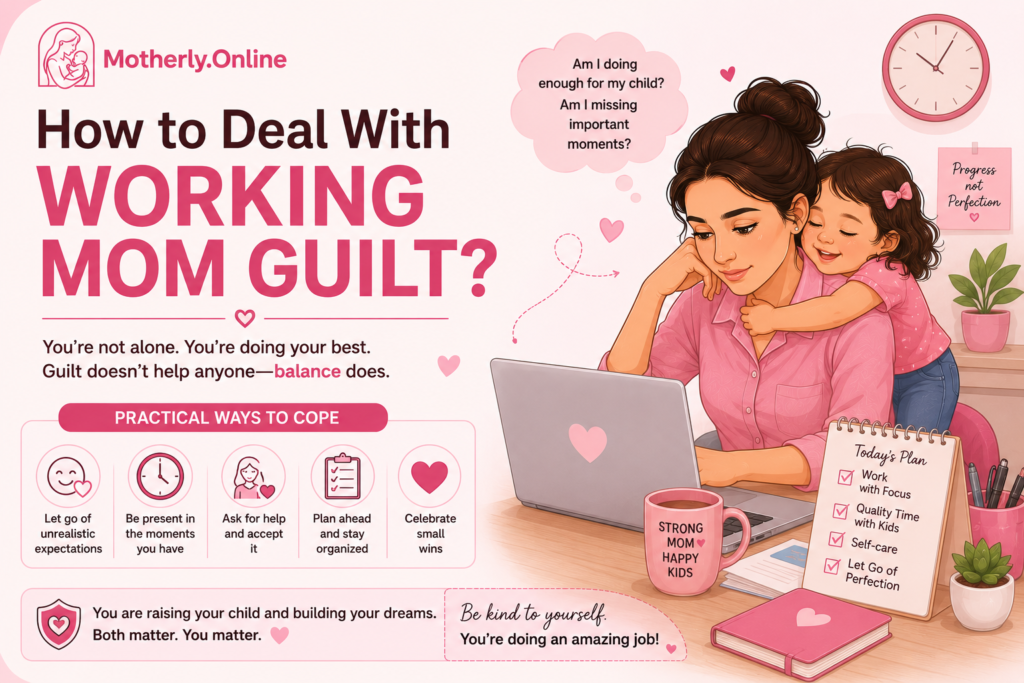

You drop your child at daycare and spend the commute wondering if you are making the right choice. You sit in a work meeting thinking about the school recital you had to miss. Then you rush home, still answering emails, and feel like you are failing at both. If any of this sounds familiar, you are dealing with working mom guilt, and you are not alone.
Working mom guilt is one of the most common emotional experiences among mothers in the workforce. A 2023 Pew Research report found that more than 60% of working mothers say they feel like they never have enough time for their children. The feeling is real. But so is this: guilt is not evidence that you are doing something wrong.
This guide gives you honest, practical strategies, not just reassuring platitudes, to help you manage working mom guilt and stop letting it erode the joy of both your career and your family life.
Table of Contents
What Is Working Mom Guilt And Why Do You Feel It?
Working mom guilt is the persistent feeling that by choosing to work, you are somehow shortchanging your children, your partner, or yourself. It often shows up as:
- Constant second-guessing about whether your children are okay without you
- Comparing yourself to stay-at-home mothers or to an imagined “perfect” version of yourself
- Feeling like you are never fully present, always distracted at home, always distracted at work
- Tying your worth as a mother to how much time you spend with your children
The root causes are both cultural and psychological. Society has long held mothers to an impossible standard: the idea that a “good mother” is always available, always nurturing, and always putting family first. When work pulls you away, guilt fills the gap. Add in social media comparisons, unsolicited opinions from family, and your own internal standards, and guilt becomes the default mode.
Why Guilt Itself Is Not the Problem, But What You Do With It Is?
A small amount of guilt can be useful. It signals that something matters to you. But chronic guilt, the kind that runs in the background all day, every day, is not a signal. It is noise.
Research in developmental psychology consistently shows that what children need most is not quantity of time but quality of engagement. A mother who works and is fully present during evenings and weekends raises children who are just as secure and confident as those raised by mothers who stay home. What harms children is not a working mother. It is a stressed, guilt-ridden, emotionally unavailable mother, whether or not she works.
Dealing with working mom guilt starts with separating the feeling from the facts.
12 Strategies to Deal With Working Mom Guilt
1. Name the Guilt Without Feeding It
When guilt arises, notice it without immediately trying to fix or suppress it. Say to yourself: “I am feeling guilty right now.” That naming creates a small distance between you and the feeling. It reduces the grip guilt has because you are observing it rather than being consumed by it.
2. Challenge the Underlying Belief
Guilt is always based on a belief, often an unconscious one. Common beliefs include “A good mother is always available” or “My child is suffering because I am at work.” Ask yourself: is that belief actually true? What is the evidence for and against it? In most cases, when examined honestly, the belief does not hold up.
3. Define What ‘Good Enough’ Looks Like for Your Family
Perfectionism and guilt are close partners. When you hold yourself to an impossible standard, always present, always cheerful, and always nutritious home-cooked meals, guilt is inevitable. Sit down and honestly define what “good enough” mothering looks like in your actual life, not in an ideal one. Then measure yourself against that standard, not someone else’s.
4. Invest in Quality Time, Not Just More Time
Ten minutes of being fully present, phone away, making eye contact, and actual listening are worth more than two hours of physically being in the same room while distracted. Protect specific windows of the day as undivided family time. Bedtime routines, morning rituals, and weekend traditions create security and connection that children carry with them all day.
5. Stop Outsourcing Your Guilt to Other People’s Opinions
Family members, other parents, social media all of them carry opinions about how you should be living your life. You do not have to hold those opinions as facts. Be selective about who you take parenting feedback from. The only opinions that should genuinely inform your choices are your partner’s and, as they grow older, your children’s.
6. Talk to Your Children About Your Work
Children understand more than we give them credit for. When you explain your work in age-appropriate terms “Mama works because it helps our family, and because she loves what she does” it demystifies your absence. It also models that work can be meaningful and fulfilling, which is a healthy lesson for children to absorb.
7. Build Reliable Childcare You Actually Trust
A huge source of working mom guilt is worry about childcare quality. If you are not confident in your childcare arrangement, guilt will be relentless. Invest time in finding care you genuinely trust whether that is a vetted nanny, a quality daycare centre, or a reliable family member. When you know your child is well cared for, the guilt softens significantly.
8. Set Boundaries at Work That Protect Family Time
Working mom guilt often intensifies when work bleeds into family time late-night emails, weekend calls, mental preoccupation. Work with your manager to define clear boundaries: when you are offline, when you are unavailable, what is genuinely urgent versus what can wait. Protecting family time is not slacking it is sustainability.
9. Let Go of Comparisons Including to Your Pre-Child Self
Comparing yourself to other mothers is an obvious trap. But equally destructive is comparing yourself to who you were before children. You are a different person now, carrying different responsibilities. Your old productivity benchmarks, social rhythms, and energy levels no longer apply and that is okay.
10. Model What You Want Your Children to Learn
When you show your children a mother who finds meaning in her work, manages her time with intention, and refuses to be destroyed by impossible standards, you are giving them a blueprint for how to live as an adult. The working mother is not depriving her children of something she is often showing them something invaluable.
11. Take Guilt as a Cue to Check In Not as a Verdict
Sometimes guilt is pointing at something real a child going through a hard patch, a season where work has taken over too much, a relationship that needs attention. Use guilt as a prompt to check in honestly, not as a verdict that you are a bad mother. Ask yourself: is something actually wrong, or am I just feeling the discomfort of normal tradeoffs?
12. Get Support Including Professional Support
Working mom guilt that becomes chronic anxiety, depression, or burnout deserves professional attention. A therapist, counsellor, or coach who specialises in working parents can help you untangle where guilt is disproportionate, where it is pointing at real changes to make, and how to build emotional resilience. You do not have to carry this alone.
Quick Reference: Working Mom Guilt Triggers and Responses
| Common Guilt Trigger | Healthier Response |
| Dropping child at daycare and they cry | Remind yourself: transition distress is normal and usually ends within minutes. A caring environment matters more than zero tears. |
| Missing a school event due to work | Acknowledge the loss honestly, then compensate with deliberate one-on-one time. One missed event does not define your relationship. |
| Bringing work stress home | Create a 10-minute decompression ritual between work and home a walk, music, or a brief pause to reset before entering family time. |
| Feeling like you enjoy work and don’t want to give it up | You are allowed to love your work. Modelling fulfilment and purpose to your children is not selfish. |
| Comparing yourself to a stay-at-home mum | Different choices suit different families. Your child needs a mother who is thriving, not a mother who is resentful. |
| Hearing ‘I want you to stay home’ | Validate the feeling. Distinguish between what your child wants in the moment and what serves your family’s long-term wellbeing. |
Frequently Asked Questions About Working Mom Guilt
Is working mom guilt normal?
Yes, it is extremely common. Studies consistently show that the majority of working mothers experience guilt at some point. The feeling does not mean you are doing something wrong it often means you care deeply about both your children and your work, and you are navigating real tradeoffs.
Does working affect my child negatively?
Decades of research show that children of working mothers are not disadvantaged compared to children of stay-at-home mothers, provided the childcare they receive is warm and consistent. In fact, studies show that daughters of working mothers tend to earn more, hold more senior positions, and report higher career satisfaction as adults.
How do I stop feeling guilty about putting my child in daycare?
Start by honestly evaluating the quality of the care if your child is in a safe, nurturing environment, the guilt is not evidence-based. Then remind yourself that daycare offers socialisation, structure, and learning that can be genuinely beneficial. Trust is the key: when you believe in your childcare provider, guilt decreases.
What if my guilt is telling me something real?
Occasionally, guilt does point to something that needs to change perhaps work has taken over too much during a critical period for your child, or you have been consistently missing important moments. Treat guilt as a prompt to check in honestly. Ask: is my child’s core need for connection, safety, and love being met? If the answer is yes, the guilt is likely disproportionate. If no, it is worth making some adjustments.
The Bottom Line
Dealing with working mom guilt is not about eliminating it entirely it is about making sure it does not run your life or distort your self-perception. You can work, achieve, contribute, and still be a deeply loving, present, and effective mother. These are not contradictions.
The goal is not to feel no guilt. The goal is to respond to it wisely to check it against facts, use it as a prompt when needed, and refuse to let it define your worth. Your children are watching how you handle hard tradeoffs. What they see is a mother who takes her responsibilities seriously, who works with purpose, and who loves them completely. That is more than enough.