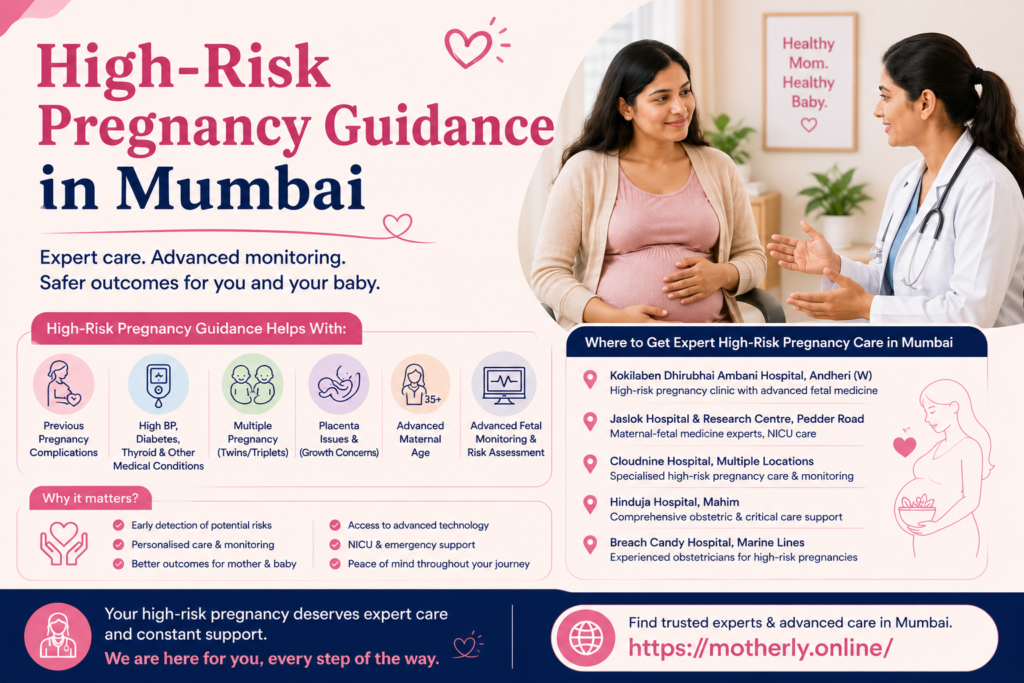

Being told your pregnancy is high risk can be frightening, but it does not mean a poor outcome is inevitable. A high-risk designation simply means that you or your baby have one or more factors that require closer monitoring and specialist management than a routine pregnancy. With the right medical guidance and support team, the vast majority of high-risk pregnancies in Mumbai result in healthy births.
Mumbai is home to some of India’s leading maternal-foetal medicine (MFM) specialists and high-risk obstetrics units. This guide explains what makes a pregnancy high risk, the types of specialist care available across the city, and how to navigate your high-risk pregnancy journey with confidence.
| 20–30% of pregnancies in urban India are classified as high risk at some point | 10–14% gestational diabetes prevalence among pregnant women in Mumbai | 5–8% of pregnancies affected by hypertensive disorders requiring specialist care | 35+ age threshold at which OB-GYNs recommend MFM specialist referral in India |
What Makes a Pregnancy High Risk?
A pregnancy may be classified as high risk due to maternal health factors, foetal conditions, obstetric history, or circumstances that develop during the pregnancy itself. Common categories include:
Maternal Health Conditions
- Gestational diabetes mellitus (GDM)
- Chronic hypertension or pregnancy-induced hypertension
- Pre-existing thyroid disorders (hypothyroidism or hyperthyroidism)
- Autoimmune conditions such as lupus or antiphospholipid syndrome
- Heart disease, kidney disease or liver disorders
- Obesity (BMI above 35) or severe underweight
Pregnancy-Specific Conditions
- Pre-eclampsia or eclampsia
- Placenta praevia or placental abruption
- Intrauterine growth restriction (IUGR)
- Polyhydramnios or oligohydramnios (abnormal amniotic fluid levels)
- Foetal structural anomalies detected on scan
- Cervical incompetence
Obstetric History Factors
- Previous preterm birth (before 37 weeks)
- Prior caesarean section or uterine surgery
- History of recurrent pregnancy loss or stillbirth
- Previous pregnancy affected by pre-eclampsia or GDM
Demographic and Lifestyle Factors
- Advanced maternal age (35 years or older at delivery)
- Multiple pregnancy (twins, triplets or higher order)
- Adolescent pregnancy (under 18 years)
- Significant smoking, alcohol use or substance exposure
| MFM Specialist Care Access to maternal-foetal medicine consultants who specialise exclusively in complex and high-risk obstetric cases. | Advanced Diagnostics Detailed foetal echocardiography, Doppler studies, genetic counselling and specialised imaging beyond standard antenatal scans. | Multidisciplinary Teams Coordinated care involving endocrinologists, cardiologists, nephrologists and neonatologists depending on your specific condition. | NICU-Ready Delivery Delivery planning at hospitals with Level 3 NICU capability for premature or medically complex newborns. |
High-Risk Conditions and Their Management in Mumbai
| Condition | Management Approach in Mumbai |
|---|---|
| Gestational Diabetes (GDM) | OGTT at 24–28 weeks, dietary management by specialist dietitian, blood glucose monitoring, insulin therapy if diet control is insufficient, growth scans every 3–4 weeks in third trimester. |
| Pre-eclampsia | Regular BP monitoring, urine protein checks, low-dose aspirin prophylaxis from 12 weeks for high-risk cases, magnesium sulphate for severe cases, early delivery if indicated. |
| Thyroid Disorders | TSH monitoring every 4–6 weeks, dose adjustment of thyroxine throughout pregnancy, foetal growth surveillance, paediatric endocrinology liaison if needed. |
| Multiple Pregnancy | Fortnightly growth scans from 28 weeks, TTTS surveillance for monochorionic twins, higher caesarean rates, Level 3 NICU delivery planning. |
| IUGR | Serial biometric scans every 2–3 weeks, umbilical artery Doppler studies, NST, steroid administration for foetal lung maturity if early delivery is anticipated. |
| Placenta Praevia | Pelvic rest, serial scan confirmation of placental position, planned caesarean if praevia persists at 36 weeks, hospital proximity planning. |
| Recurrent Pregnancy Loss | Thrombophilia screening, antiphospholipid antibody testing, progesterone supplementation, early viability scans and enhanced first trimester monitoring. |
| “I was 37 when I got pregnant with twins. I was genuinely terrified. My MFM specialist at the hospital in Powai had a clear protocol from week 12 itself. By the end I felt like the most monitored patient in Mumbai, but I also felt the safest.”— Anjali M., Powai, Mumbai |
Specialist Centres for High-Risk Pregnancy in Mumbai
Government Tertiary Centres
- KEM Hospital, Parel: Strong MFM unit with foetal medicine subspecialty services
- Lokmanya Tilak Municipal General Hospital (Sion): Comprehensive high-risk obstetrics and Level 3 NICU
- Nair Hospital, Mumbai Central: Gestational diabetes and hypertensive disorders management
- Cama and Albless Hospital, Fort: Dedicated women’s hospital with high-risk antenatal unit
Private Hospitals with Dedicated High-Risk Units
- Kokilaben Dhirubhai Ambani Hospital, Andheri West: MFM specialists and Level 3 NICU
- Lilavati Hospital, Bandra West: Advanced foetal medicine and maternal cardiology services
- Hiranandani Hospital, Powai: High-risk obstetrics unit with neonatology support
- Hinduja Hospital, Mahim: Multidisciplinary maternal-foetal care
- Jaslok Hospital, Pedder Road: High-risk pregnancy management and genetic counselling
- Jupiter Hospital, Thane: NICU-equipped high-risk delivery centre serving eastern suburbs
| When selecting a hospital for a high-risk delivery in Mumbai, confirm that the facility has a Level 3 NICU on site (not just Level 1 or 2) and that paediatric neonatologists are available 24/7. This is particularly important for twins, preterm risk and foetal anomaly cases. |
High-Risk Pregnancy Monitoring Schedule
| Condition | Recommended Monitoring Frequency | Key Parameters |
|---|---|---|
| Gestational Diabetes | Every 2–3 weeks from diagnosis | Blood glucose diary, HbA1c, foetal growth, amniotic fluid |
| Pre-eclampsia Risk | Fortnightly from 28 weeks | Blood pressure, proteinuria, foetal Doppler, platelets, LFT |
| Multiple Pregnancy (dichorionic) | Every 4 weeks to 28 weeks, then fortnightly | Individual foetal growth, cervical length, fluid levels |
| Multiple Pregnancy (monochorionic) | Every 2 weeks from 16 weeks | TTTS surveillance, amniotic fluid discordance |
| IUGR | Every 2–3 weeks with Doppler | Abdominal circumference, umbilical artery Doppler, NST |
| Advanced Maternal Age 35+ | Monthly until 28 weeks, fortnightly thereafter | Growth, BP, anomaly follow-up, third trimester wellbeing |
Mental Wellness During High-Risk Pregnancy
The psychological burden of a high-risk pregnancy is significant and often underaddressed. Anxiety, depression and fear of foetal harm are common experiences among high-risk pregnant women. Access to prenatal mental health support is an important component of comprehensive high-risk care.
Services available in Mumbai include:
- One-on-one counselling with psychologists trained in perinatal mental health
- Peer support groups for women with specific conditions such as recurrent pregnancy loss or GDM
- Mindfulness and relaxation workshops offered alongside antenatal care programmes
- Partner and family counselling to support the wider support network
Frequently Asked Questions: High-Risk Pregnancy Guidance in Mumbai
If my pregnancy is high risk, does that mean I will need a caesarean?
Not necessarily. High-risk status increases the monitoring intensity of your pregnancy but does not automatically mean a caesarean is required. Many high-risk conditions, including controlled GDM and well-managed hypertension, are compatible with a planned vaginal delivery. The decision depends on your specific condition, foetal position and cervical readiness near term.
What is a maternal-foetal medicine (MFM) specialist and when do I need one?
A maternal-foetal medicine specialist is an obstetrician with additional subspecialty training in managing complex and high-risk pregnancies. You may be referred to an MFM specialist if you have a pre-existing medical condition, a foetal anomaly is suspected on scan, your pregnancy involves multiples, or you have a significant obstetric history. MFM specialists are available at most major private hospitals and government medical colleges in Mumbai.
Can I deliver at my regular gynaecologist’s clinic if my pregnancy is high risk?
It depends on the nature of your risk. Some high-risk conditions such as mild GDM or borderline hypertension may be managed at a well-equipped private hospital by your regular OB-GYN. However, conditions such as preterm risk, foetal anomalies, multiple pregnancies or severe pre-eclampsia require delivery at a hospital with a Level 3 NICU and on-site MFM support. Discuss your specific situation with your doctor.
Will high-risk pregnancy care in Mumbai cost significantly more?
High-risk pregnancy care typically involves more frequent consultations, additional scans and specialised tests, which increases total cost. However, government hospitals and medical colleges in Mumbai provide high-risk obstetric services at significantly subsidised rates. If you have health insurance, check whether your policy covers MFM consultations, additional scans and extended hospital stays.
What emotional support is available for high-risk pregnancies in Mumbai?
Several hospitals and standalone clinics in Mumbai offer perinatal mental health support as part of high-risk antenatal care. Psychologists, counsellors and peer support groups specialising in conditions such as recurrent pregnancy loss, foetal diagnosis anxiety and GDM stress are accessible across the city. Ask your OB-GYN or MFM specialist for a referral if you are experiencing significant anxiety or low mood.
| Find High-Risk Pregnancy Guidance in Mumbai Connect with verified MFM specialists and high-risk obstetrics teams at hospitals across Andheri, Powai, Bandra, Mahim and Thane. Expert care for every kind of pregnancy. |