
Knowledge is one of the most powerful tools a mother can have going into labour and delivery. Childbirth education classes transform the unknown into the familiar, replacing fear with preparation and uncertainty with informed confidence. In Mumbai’s busy urban environment, where families often cannot rely on extended family knowledge networks, structured birth education classes fill a critical gap in antenatal support.
This guide covers what childbirth education involves, the different programme formats available in Mumbai, what to expect at each session and how to choose the right class for your birth preferences and family situation.
| 80% of first-time parents report feeling underprepared for the actual labour experience | 32–36 weeks gestation: ideal window to complete a comprehensive childbirth education series | 40% lower epidural rates among parents who complete structured birth preparation programmes | 6–12 hrs typical length of a comprehensive childbirth education series across 3 to 5 sessions |
What Are Childbirth Education Classes?
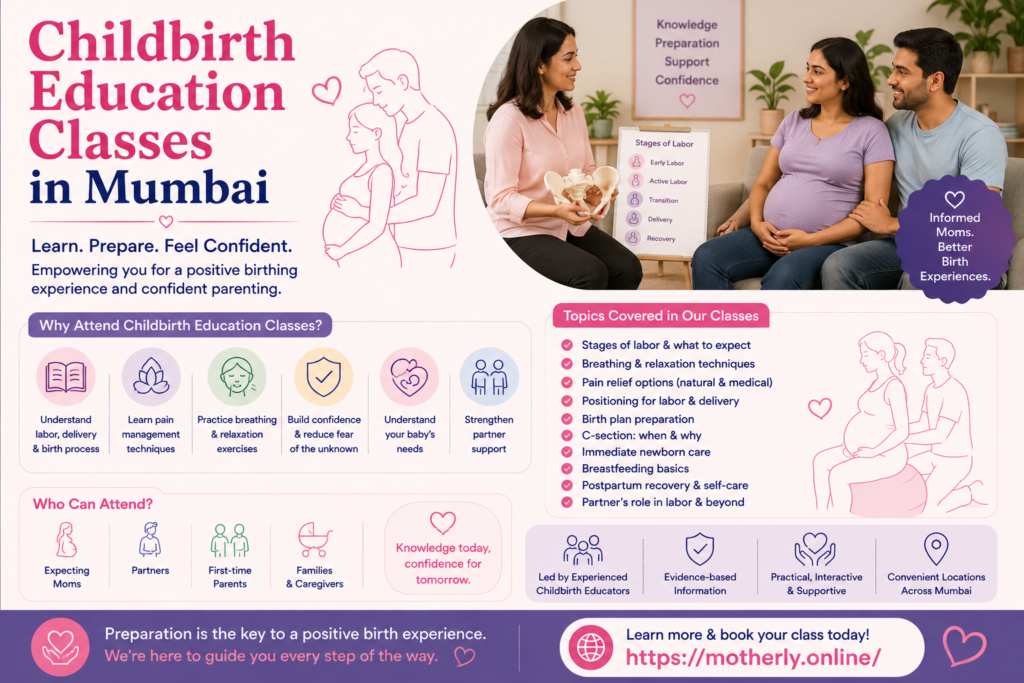
Childbirth education classes are structured educational programmes designed to prepare expecting parents for the physical, emotional and practical aspects of labour, delivery and the early newborn period. They are facilitated by certified childbirth educators, midwives, nurses or doulas and typically attended by both the mother and her birth partner.
Good childbirth education is not prescriptive. It does not tell you how you must give birth. Instead, it gives you the information and tools to make genuinely informed decisions about your own birth experience based on your values, medical situation and preferences.
| Labour Education Detailed understanding of the stages of labour, cervical dilation, transition and the second stage to eliminate fear of the unknown. | Pain Management Tools Breathing techniques, movement, counter-pressure, hydrotherapy, position changes and medical options explained in practical detail. | Newborn Readiness Baby care basics including feeding, bathing, safe sleep, cord care, jaundice recognition and newborn behaviour cues. | Birth Partner Training Specific tools and role guidance for partners and support persons to be active and effective during labour and delivery. |
Core Topics Covered in Childbirth Education Classes
Understanding Labour
- The three stages of labour and what happens physiologically in each
- Early labour, active labour and transition: what to expect and how to respond
- When to go to hospital and what to bring
- How hospital admission and assessment works
Pain Management and Coping Strategies
- Breathing patterns for different phases of labour (slow breathing, modified paced breathing, transition breathing)
- Movement and positioning during labour: walking, rocking, hands-and-knees, squat, side-lying
- Counter-pressure, heat application and water therapy for pain relief
- Epidural anaesthesia: how it works, when to ask for it, side effects and limitations
- Other medical pain relief options including Entonox and IV opioids where available
Birth Scenarios and Options
- Vaginal birth: normal progress, coaching for pushing, episiotomy discussion
- Caesarean section: elective and emergency, what the procedure involves, recovery
- Instrumental delivery: forceps and vacuum, when and why they are used
- Induction of labour: methods, reasons and what to expect
Immediate Postpartum
- Delayed cord clamping and third stage management
- Skin-to-skin contact and golden hour
- Initial breastfeeding and colostrum
- Newborn checks, Vitamin K and hepatitis B vaccination
Newborn Care Basics
- Feeding: breastfeeding fundamentals and formula feeding if relevant
- Bathing, cord care, nappy changing
- Safe sleep guidelines (back sleeping, firm mattress, safe sleeping environment)
- Recognising normal vs concerning newborn behaviour
- When to call the paediatrician in the first days
| “We did a four-session childbirth class in Bandra at 34 weeks. My husband came to all of them and it completely changed his confidence going into the delivery. When active labour started he knew exactly what to do, what I needed and when to ask for help. We both wish we had done it for our first too.”— Pallavi K., Bandra West, Mumbai |
Types of Childbirth Education Programmes Available in Mumbai
| Programme Type | What to Know |
|---|---|
| Lamaze Method | Focus on breathing techniques, movement and confidence in the body’s natural ability to birth. Emphasises informed decision-making and partner involvement. Available through certified Lamaze educators in Mumbai. |
| Bradley Method | Partner-coached natural childbirth approach. 12-week programme covering deep relaxation, nutrition and partner training. Less widely available in Mumbai but can be found through certified instructors. |
| Hypnobirthing | Uses self-hypnosis, visualisation and affirmations to reframe birth as a calm, manageable experience. Particularly popular among mothers with birth fear or anxiety. Several certified practitioners in Andheri, Juhu and Bandra. |
| Hospital Antenatal Classes | Offered by most private hospitals in Mumbai as part of maternity packages. Cover hospital policies, birth procedures and newborn care basics. Practical but less personalised than independent programmes. |
| Private Group Classes | Small groups of 6 to 12 couples led by an independent educator or doula. Balance personalisation with community connection. Available across Mumbai at Rs 3,000 to Rs 8,000 per series. |
| Private One-on-One Sessions | Fully personalised curriculum for families with specific needs, high-risk pregnancies, past birth trauma or complex birth plans. Higher cost but maximum relevance. |
| What to Look For in a Mumbai Childbirth Educator: Confirm your educator holds a recognised certification such as CAPPA (Certified Childbirth Educator), DONA, Lamaze LCCE, or Bradley certification. Ask whether the programme covers both vaginal and caesarean birth preparation and whether it is updated to reflect current Mumbai hospital policies. |
What Does a Typical Childbirth Education Series Look Like?
| Session | Topic Coverage |
|---|---|
| Session 1 | Anatomy of pregnancy and birth, how the uterus works, stages of labour, signs that labour has started |
| Session 2 | Pain management options: natural techniques (breathing, movement, water, counter-pressure) and medical options (epidural, opioids) |
| Session 3 | Labour and birth scenarios: vaginal birth, caesarean section, induction, instrumental delivery, birth plans |
| Session 4 | The immediate postpartum period, skin-to-skin, breastfeeding first steps, newborn checks, birth partner role in recovery |
| Session 5 (if included) | Newborn care, safe sleep, feeding, paediatric guidance, postpartum recovery for the mother, early parenting support |
Childbirth Education for Specific Situations
Repeat Caesarean or Planned Caesarean
Parents planning a caesarean, whether elective or following a previous section, benefit from childbirth education that specifically addresses surgical birth preparation, recovery, skin-to-skin options in theatre and VBAC decision-making in future pregnancies.
Previous Traumatic Birth
Mothers with a history of traumatic birth, emergency interventions or PTSD from a previous delivery benefit from specialised birth debriefing and trauma-informed childbirth education. This is available through select perinatal educators and psychologists in Mumbai.
Multiple Pregnancies
Twin and triplet births involve additional considerations around delivery mode, NICU preparation and tandem newborn care. Seek childbirth education that specifically addresses multiple birth scenarios.
Single Parents and Non-Partner Birth Companions
Birth education is equally valuable for single mothers and those attending with a non-partner birth companion such as a family member, friend or doula. The birth companion’s role is just as important regardless of relationship type.
Frequently Asked Questions: Childbirth Education Classes in Mumbai
When is the best time to attend childbirth education classes in Mumbai?
Most programmes recommend attending between 28 and 36 weeks of pregnancy. Starting too early means some of the content feels abstract; starting too late may mean you do not have time to complete a multi-session series before delivery. For a 4 to 5 session programme, starting at around 30 weeks is ideal.
Should my partner attend childbirth education classes with me?
Yes, strongly recommended. Research consistently shows that partners who attend birth preparation classes provide more effective labour support, experience lower anxiety during delivery and have a more positive early parenting adjustment. Birth partners do not need to be romantic partners; a trusted friend, sibling or doula companion is equally valid.
Are childbirth education classes useful if I am planning a caesarean section?
Absolutely. Even with a planned caesarean, childbirth classes prepare you for the surgical experience itself, the immediate postpartum period, skin-to-skin options in theatre, breastfeeding initiation and recovery. They also prepare you for the possibility of an unplanned caesarean if you are attempting a vaginal birth.
How much do childbirth education classes cost in Mumbai?
Hospital-based antenatal classes are often included in private hospital maternity packages at no additional cost. Independent group programmes typically cost Rs 3,000 to Rs 8,000 for a complete series of 3 to 5 sessions. Private one-on-one programmes can range from Rs 10,000 to Rs 25,000 for a full package. Online programmes from certified Mumbai educators are available at lower price points.
What is the difference between a childbirth class and a hospital antenatal tour?
A hospital antenatal tour familiarises you with the physical layout of the maternity ward, admission procedures and hospital-specific protocols. A childbirth education class provides in-depth preparation for the physical and emotional experience of labour, delivery and newborn care. Both are valuable and serve different purposes; ideally, do both.
| Book Childbirth Education Classes in Mumbai Prepare for labour and delivery with certified childbirth educators across Bandra, Andheri, Juhu, Powai and Dadar. Classes for first-time parents, repeat parents and birth partners. Book Your Session Now |