
Prenatal yoga is one of the most widely recommended complementary practices during pregnancy. Combining gentle movement, focused breathwork and mindful relaxation, it addresses many of the physical and emotional challenges that arise across the three trimesters. In a city like Mumbai, where urban stress is a constant and pregnancy can feel isolating without the right community, prenatal yoga classes offer both physical relief and meaningful connection.
This guide covers the benefits of prenatal yoga during pregnancy, what to expect from classes in Mumbai, how practice changes across each trimester, and how to find the right studio or instructor for your needs.
| 25% reduction in perceived labour pain reported by regular prenatal yoga practitioners | 3x/week optimal prenatal yoga frequency recommended for maximum benefit during pregnancy | 35% lower rates of preterm birth associated with regular mindful movement in pregnancy | 2nd trimester widely considered the ideal time to begin or intensify a prenatal yoga practice |
Benefits of Prenatal Yoga During Pregnancy
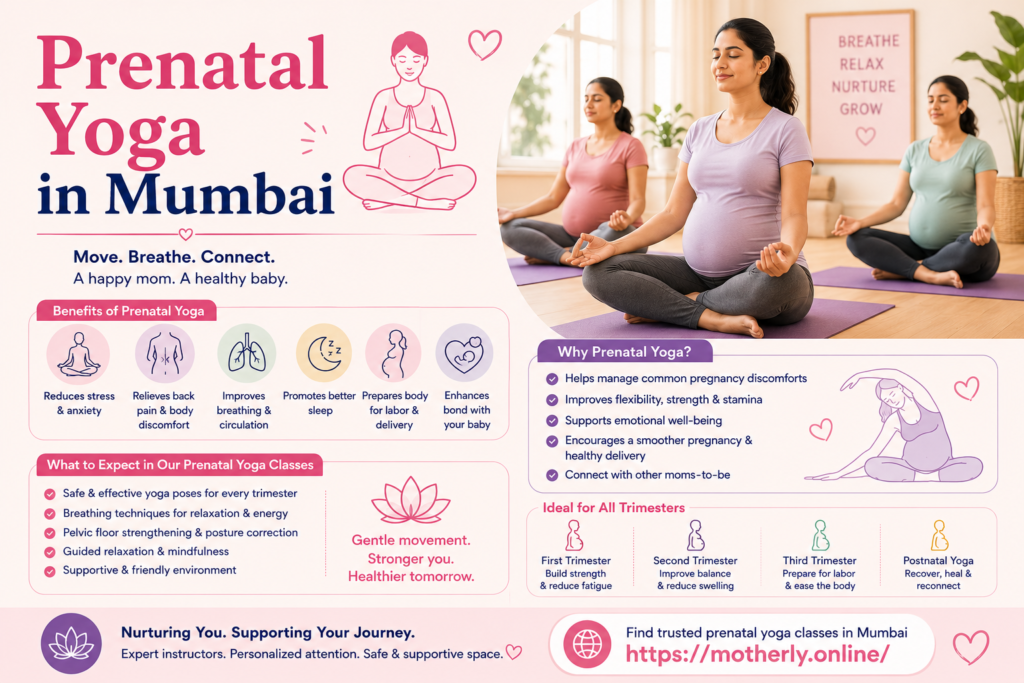
Prenatal yoga is adapted from traditional yoga practices to address the specific needs and limitations of the pregnant body. Research and clinical observation consistently point to the following benefits:
Physical Benefits
- Relieves lower back pain and sciatica, among the most common pregnancy complaints
- Reduces hip tightness and pelvic girdle discomfort as the pelvis widens
- Improves posture and spinal alignment to accommodate the growing belly
- Builds pelvic floor strength, which supports both delivery and postpartum recovery
- Reduces leg cramps, ankle oedema and varicose veins through improved circulation
- Supports optimal foetal positioning in the third trimester through specific pelvic movements
Mental and Emotional Benefits
- Reduces cortisol and stress hormones that can negatively affect foetal development
- Addresses prenatal anxiety and sleep disturbances through breathwork and relaxation techniques
- Builds body awareness and confidence ahead of labour
- Creates a sense of connection and community with other expecting mothers
Labour Preparation Benefits
- Pranayama (breathing techniques) directly translate to pain management during contractions
- Hip-opening poses prepare the pelvis for delivery
- Focused relaxation practices reduce fear and resistance during labour
- Strengthened core and pelvic floor support effective pushing during vaginal birth
| Trimester-Adapted Postures Yoga sequences modified for each stage of pregnancy, with props and adjustments ensuring safety as the body changes. | Pranayama & Breathwork Breathing techniques including ujjayi, viloma and nadi shodhana to manage stress, improve oxygenation and prepare for labour. | Pelvic Floor Training Mula bandha, kegel exercises and hip-opening sequences to strengthen and release the pelvic floor for childbirth and recovery. | Mindfulness & Yoga Nidra Deep relaxation and guided meditation practices that reduce prenatal anxiety and improve sleep quality throughout pregnancy. |
Trimester-by-Trimester Prenatal Yoga Guide
| Trimester | Practice Focus | Recommended Poses | Poses to Avoid |
|---|---|---|---|
| First (Weeks 1–13) | Gentle movement, nausea management, fatigue support, early connection with breath | Cat-cow, supported child’s pose, seated forward fold, gentle hip circles, sukhasana breathing | Deep twists, intense inversions, strong backbends, hot yoga, Bikram |
| Second (Weeks 14–27) | Hip opening, spinal extension, strength building, pelvic floor, lateral stretching | Warrior 2, triangle, wide-legged squat (malasana), pigeon with support, butterfly | Lying flat on back for extended periods, strong abdominal work, deep belly twists |
| Third (Weeks 28–40) | Foetal positioning, pelvic release, labour preparation, breathwork for contractions | Supported squat, side-lying savasana, wall-supported warrior, cat-cow, pelvic tilts on ball | Inversions without expert guidance, any pose causing pressure on the abdomen |
| “I joined a prenatal yoga class in Juhu at 16 weeks and it became the highlight of my week. The teacher modified everything for my back pain and by my third trimester I had a toolkit of breathing techniques I genuinely used during labour. I cannot recommend it enough.”— Preethi N., Juhu, Mumbai |
What to Expect at a Prenatal Yoga Class in Mumbai
Prenatal yoga classes in Mumbai are typically 60 to 75 minutes long and structured as follows:
- Opening centering and breath awareness (5 to 10 minutes)
- Gentle warm-up sequence addressing neck, shoulders and spine
- Standing and seated postures adapted for pregnancy with block and bolster support
- Hip-opening and pelvic floor sequence
- Breathwork practice relevant to the group’s trimester range
- Guided relaxation or yoga nidra (10 to 15 minutes)
- Closing and sharing circle in group classes
Most studios in Mumbai require a doctor’s clearance for participation, particularly for women in the first trimester or those with high-risk pregnancies. Always inform your instructor of any complications, previous pregnancy losses or physical limitations at the start of each class.
Private vs Group Prenatal Yoga in Mumbai
| Format | Best Suited For |
|---|---|
| Group Studio Classes | Mothers seeking community, social connection and shared experience. Available at yoga studios across Bandra, Juhu, Andheri, Dadar and Powai. Typically Rs 600 to Rs 1,500 per class. |
| Private One-on-One Sessions | Mothers with specific physical conditions, high-risk pregnancies, back pain, SPD or a need for highly personalised sequencing. Priced at Rs 1,500 to Rs 4,000 per session in Mumbai. |
| Online Prenatal Yoga | Mothers in suburban areas including Navi Mumbai, Thane and Mira Road, or those with travel or timing constraints. Quality varies widely; look for certified instructors with prenatal specialisation. |
| Hospital-Based Antenatal Yoga | Offered as part of prenatal classes at hospitals such as Kokilaben, Hiranandani and Lilavati. Often included in antenatal package fees. Medically supervised setting. |
| Certification Check: When choosing a prenatal yoga instructor in Mumbai, confirm they hold a recognised prenatal yoga teaching certification (such as Yoga Alliance RPYT, CAPPA, or equivalent) in addition to a general yoga teaching qualification. Pregnancy-specific training is essential for safe adaptation of postures. |
Is Prenatal Yoga Safe for All Pregnancies?
Prenatal yoga is safe for the majority of healthy pregnancies when practised under qualified guidance. However, it is not recommended without specific medical clearance in the following situations:
- Placenta praevia diagnosed after 20 weeks
- Preterm labour risk or cervical incompetence
- Severe pre-eclampsia or uncontrolled hypertension
- Multiple pregnancies after 28 weeks (light practice may be approved on a case-by-case basis)
- Premature rupture of membranes
Always discuss your intention to practice prenatal yoga with your OB-GYN before beginning, and always inform your yoga instructor of your complete health picture. A qualified prenatal instructor will never encourage you to override medical advice.
Frequently Asked Questions: Prenatal Yoga in Mumbai
I have never done yoga before. Can I join prenatal yoga classes in Mumbai as a complete beginner?
Absolutely. Most prenatal yoga classes in Mumbai are designed for all levels of experience, including complete beginners. Unlike regular yoga classes, prenatal sessions do not assume prior practice and prioritise safety and accessibility over advancement. Beginners are often encouraged to start in the second trimester when energy levels are typically more stable.
Is it safe to continue yoga in the third trimester?
Yes, with appropriate modifications. The third trimester is actually when prenatal yoga is often most valuable for birth preparation. Poses are adapted to accommodate the larger belly, and the emphasis shifts to breathwork, pelvic release and relaxation techniques that directly support labour. Lying flat on the back is avoided after 28 weeks; side-lying and supported upright positions are used instead.
How is prenatal yoga different from regular yoga during pregnancy?
Prenatal yoga avoids postures that compress the abdomen, deep twists, strong inversions, and extended supine positions. It specifically incorporates pregnancy-relevant sequences including pelvic floor training, hip-opening for labour preparation and breathwork for contraction management. The pace is gentler and the use of props is far more extensive than in standard yoga classes.
Can prenatal yoga help my baby get into the correct position for birth?
Certain prenatal yoga postures are associated with encouraging optimal foetal positioning, particularly head-down engagement in the third trimester. Forward-leaning positions, hands-and-knees cat-cow sequences and wide-legged squats are commonly used for this purpose. While yoga cannot guarantee foetal position, it is a commonly recommended complementary approach alongside spinning babies techniques and midwifery guidance.
At what point in pregnancy should I stop attending prenatal yoga?
There is no fixed cut-off. Many women practice gentle prenatal yoga right up to 38 or 39 weeks. In the final weeks, intensity naturally reduces and the focus shifts almost entirely to breathwork and relaxation. Your instructor and OB-GYN will guide you based on your individual progress and comfort.